
"Run at once" almost always means "run it once" in poker: dealing the remaining board a single time, instead of running it twice and splitting the pot across two boards. Running it twice cuts your swings by about 29% but leaves your expected winnings unchanged. Traders borrow the same idea when they run several robots at once, and it only smooths results if the robots don't lose together.
TL;DR:
- "Run it" means dealing out the rest of the board after the last bet; "run it once" is the default, "run it twice" splits the pot across two boards.
- At 50% equity, running it twice drops your chance of winning the whole pot from 50% to 25% and your standard deviation from 50% to about 35% of the pot, while your expected value stays identical.
- Players agree to run it twice to protect a bankroll, keep a game friendly, or take some of the sting out of a bad beat.
- Running several trading robots at once follows the same math, but only if risk is split between them and their results aren't highly correlated.
- Two uncorrelated robots at half size beat four similar robots at full size, because correlated robots lose together.
Table of Contents
- What "Run at Once" Means: Run It Once vs. Run It Twice
- What "Running It Twice" Means in Texas Hold'em, With the Actual Math
- Why Poker Players Agree to Run It Twice (and When to Say No)
- Run at Once Online and in Games: Where the Option Exists
- Running Multiple Robots at Once: The Same Math, a Different Table
- Where Running Robots at Once Goes Wrong: Size and Correlation
- How I'd Decide: Rules for Running More Than One Robot
- Get a Rotating Squad of Trading Robots Without Juggling Them Yourself
- Frequently Asked Questions
- Sources
What "Run at Once" Means: Run It Once vs. Run It Twice
When you type "run at once" into a search box, you usually land in poker, because the phrase is a close cousin of "run it once." Here is the plain-English version.
"Run it" means deal out the rest of the board. In Texas Hold'em, once every player still in the hand is all-in and no more betting is possible, the dealer reveals the remaining community cards. That act is "running it" or "running it out." The glossary of poker terms on Wikipedia lists both phrases as standard table slang.
"Run it once" is the default. One board, one winner (or a split if the board ties), and the whole pot goes to whoever's hand holds up.
"Run it twice" is the opt-in alternative. The players deal the remaining cards two separate times and each board wins half the pot. It is a negotiated option, mostly found in cash games, and it is usually agreed before any cards come out.
The search results for this phrase are mostly poker training and discussion pages. If you came here from a trading background, hold that thought, because the same math shows up again in the second half of this article.
What "Running It Twice" Means in Texas Hold'em, With the Actual Math

Say you and an opponent are all-in on the turn for a $400 pot, and you are a dead-even 50% to win. Here is what changes when you run it twice.
| Outcome | Run once | Run twice |
|---|---|---|
| You win the whole pot | 50% | 25% |
| You win one board, lose one (split) | 0% | 50% |
| You lose the whole pot | 50% | 25% |
| Expected value | $200 | $200 |
| Standard deviation (as share of pot) | 50% | about 35% |
The second board is dealt from the same deck minus the cards already used, so the two runs are nearly independent rather than perfectly so. The table treats them as independent, which is close enough for decision-making.
Run it twice at 50% equity and your chance of scooping the whole pot drops from 50% to 25%. Your expected win does not move by a single cent.
That is the key distinction. Running it twice is a variance decision, not an edge decision. If you are a favorite, you stay a favorite. If you are a dog, you stay a dog. You just see the verdict delivered in two installments, so the final score is less likely to be a blowout in either direction.
Why Poker Players Agree to Run It Twice (and When to Say No)
Since the expected value is identical, why do poker players agree to run it twice at all? There are four honest reasons.
- Bankroll protection. If the pot is large relative to your roll, a single coin flip can wreck a month. Splitting the flip into two shrinks the odds of a total loss from 50% to 25%.
- Table goodwill. In a friendly home game or a regular cash game, saying yes keeps everyone relaxed, and a relaxed table is a profitable table for the better players.
- Tilt control. Losing a big pot to a single river card is the kind of beat that makes people play badly for the next hour. Two boards soften that blow.
- Lower regret. Many players simply prefer a result closer to their actual equity.
When should you decline? If you are a clear favorite and your bankroll is comfortable, the choice is a wash mathematically, so I would say yes to keep the game friendly. If you are the short stack in a game you are trying to hold onto, I would say yes for the bankroll reason. The only time I would say no is when the table is split on the rule or the house charges extra for it. Many tournaments also don't allow it, so check the rules before assuming.
Run at Once Online and in Games: Where the Option Exists
Related searches like "run at once game" and "run at once online" usually point to poker software or practice tools. A few practical points apply.
Availability varies. Some online poker rooms offer run-it-twice as a table setting or a player-by-player opt-in. Others don't offer it at all. Check the room's rules before you sit down.
Both players usually must agree. Online, the system typically asks every all-in player, and a single "no" means the board runs once.
Practice tools can show you the difference. Any equity calculator will give you your win percentage on a given board. Compare it against a 25/50/25 split and you will see why the swings shrink.
If you were searching for a software command or a game with a different "run at once" meaning, the poker usage is by far the dominant one, but the variance idea in the next section applies far beyond cards.
Running Multiple Robots at Once: The Same Math, a Different Table

Traders ask the same question about automated systems: should you run several expert advisors at once? The logic mirrors run-it-twice. Splitting your risk across two independent bets reduces the swings without changing the average.
This is old news in finance. Harry Markowitz's 1952 paper "Portfolio Selection" in The Journal of Finance laid out the principle that combining assets with imperfectly correlated returns reduces overall risk for the same expected return. Two robots are two assets.
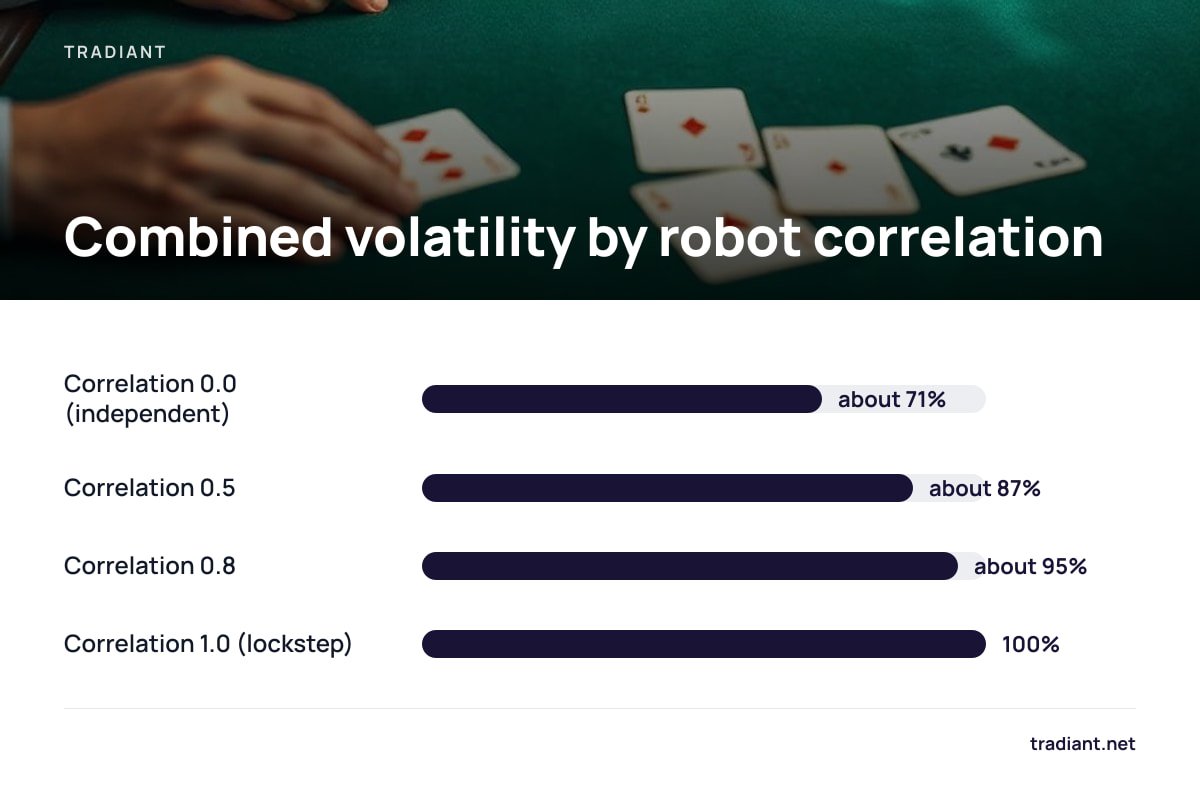
Here is how much a 50/50 split between two equally volatile robots actually helps, depending on how correlated they are.
| Correlation between robots | Combined volatility vs. one robot |
|---|---|
| 0.0 (fully independent) | about 71% |
| 0.5 | about 87% |
| 0.8 | about 95% |
| 1.0 (move in lockstep) | 100% |
At zero correlation you get exactly the run-it-twice benefit: a cut of about 29%. At 0.8 you get almost nothing, a 5% cut, while paying double the complexity.
Where Running Robots at Once Goes Wrong: Size and Correlation
Poker's run-it-twice has a built-in safety feature: the pot is split in half. Trading has no such feature. That is where the obvious answer turns out to be wrong.
Adding a robot usually adds risk. If robot A risks 1% per trade and you switch on robot B at the same size, you now risk up to 2% on the same account at the same moment. You did not split the pot. You doubled the bet. The diversification math in the table only applies when you cut each robot's size so total risk stays the same.
Correlation is the hidden trap. Two trend-following robots that both go long the same currency are not two bets, they are one bet with two tickets. A single news shock hits both.
Leverage compounds the problem. Regulators cap retail leverage because it turns small moves into account-ending ones. The European Securities and Markets Authority set limits for retail CFD trading, including 30:1 on major currency pairs, and Australia's ASIC applies a similar 30:1 cap for retail clients. Those caps assume one position at a time is not the whole account. Stack three robots and you can still blow through your comfort zone fast.
Two robots each risking 2% per trade can put 4% of your account on the line from a single move in the dollar.
Stops need a portfolio view. A stop loss protects a single trade. When several robots run together you also need an account-level drawdown limit, and you need to understand how stop and limit orders actually fill in fast markets, because gaps can skip right past the level you chose.
How I'd Decide: Rules for Running More Than One Robot

I would pick two genuinely different robots at half size each over four similar robots at full size. Here is the checklist I would use.
- Fix total risk first. Decide the maximum you will lose on a bad day or a bad month, then divide it among the robots. Do not set each robot's risk separately.
- Check what each robot actually does. A trend-follower and a range-trader tend to have different good and bad stretches. Two trend-followers on the same pairs do not.
- Look at overlap, not just names. If both robots trade the same currency pairs in the same sessions, treat them as one.
- Set an account-level stop. If total drawdown hits your limit, everything pauses, and you review before restarting.
- Add one robot at a time. Run each new one for a few weeks before judging how it interacts with the others.
Pro Tip: Compare robots by their losing weeks, not their winning ones. Line up the five worst weeks of each robot's history. If the same calendar weeks appear on both lists, the pair is far more correlated than their average returns suggest, and running them together will not give you the run-it-twice smoothing you are paying for.
If you are weighing alternatives to doing this yourself, copy trading has its own version of this problem, because following several traders can quietly stack the same exposure.
Get a Rotating Squad of Trading Robots Without Juggling Them Yourself
The headache this article describes is real: sizing several robots, watching correlation, and deciding who plays when. Tradiant is building a managed service that handles that for you. It runs a rotating squad of robots on your own broker account, starting with Goldenhawk, a trend-following robot, and a live team sheet will show who is active and who is on the bench. Your money stays with your broker, you start from $500, and you keep 80% of profits. The 20% success fee uses a high-watermark, so you pay nothing in losing months and nothing until the account passes its previous peak. There are no setup, monthly or management fees. It is a hands-off way to get some of the smoothing without doing the math yourself, and our guide to managed account custody and fees shows what to compare.
The honest caveat: the service opens in early 2027, so it is not live yet, and trend-following can sit through long flat or losing stretches. Rotating robots reduces risk, but it never removes it, and you can lose money. Read the spec sheet, including ours, before you deposit anything.
Frequently Asked Questions
What does "run it" mean in poker?
"Run it" means dealing out the rest of the community cards once all remaining players are all-in and no more betting is possible. "Run it once" is the standard single deal, and "run it twice" deals the remaining cards two times with half the pot awarded to each board.
What does "running it twice" mean in Texas Hold'em?
It means the players deal the remaining board cards two separate times and award half the pot to the winner of each. If you win both boards you take the whole pot, if you split them you each get half, and if you lose both you lose the pot.
Why do poker players agree to run it twice?
The expected value is the same either way, so players agree mainly to reduce variance. It protects a bankroll from a single coin-flip loss, keeps the game friendly, and softens the tilt that comes from losing a big pot on one card.
Does running it twice change your odds of winning?
No. Your equity is the same, so your expected winnings don't change. What changes is the spread of outcomes: at 50% equity, your chance of winning the whole pot falls from 50% to 25%, and you get a 50% chance of splitting.
Is it safe to run several trading robots at once?
It can be, but only if you cut each robot's size so total risk stays fixed and the robots don't behave alike. Running two robots at full size on one account doubles your exposure, and correlated robots tend to lose at the same time.
Is "run at once" the same as "run it once"?
In search results, yes. People typing "run at once" are usually looking for "run it once," the standard single-board deal in poker, and the results are dominated by poker content for that reason.
Sources
- Glossary of poker terms | Wikipedia
- Portfolio Selection (Harry Markowitz, The Journal of Finance, 1952) | JSTOR
- European Securities and Markets Authority | ESMA
- Australian Securities and Investments Commission | ASIC
