
A stop loss limit order is a stop order that, once your trigger price is hit, turns into a limit order instead of a market order. The distinction that matters is what it guarantees: a plain stop loss guarantees an exit but not the price, while a stop loss limit guarantees the price but not the exit. In a fast-moving or gapping market, that second version can leave you holding a losing position with no fill at all.
TL;DR:
- A stop loss limit order becomes a limit order once triggered, so it can fail to fill if price jumps past your limit price in one move.
- A plain stop loss (stop-market) always gets you out, but the fill price during fast moves or gaps can be worse than you planned.
- Gaps happen most around major news, weekend opens, and thin-liquidity hours — exactly when a stop-limit is most likely to miss.
- Size the gap between your stop price and limit price using average volatility (ATR), not a fixed number of pips, so it scales with the pair you're trading.
- If you run more than one EA or strategy on an account, per-trade stops don't cap total drawdown — you need an account-level limit too.
Table of Contents
- Stop Loss vs Stop Loss Limit: The Difference That Decides Whether You Get Filled
- How a Stop Loss Limit Order Actually Works, Step by Step
- Stop Loss vs. Stop-Limit vs. Guaranteed Stop: What Each One Promises
- When a Stop Loss Limit Order Leaves You Stuck in a Losing Trade
- Setting Your Stop Distance: ATR, Percentage, and Market Structure
- Running Multiple EAs? Why a Single Stop Loss Limit Isn't a Risk Plan
- Get Account-Level Risk Limits Without Building the Spreadsheet Yourself
- Frequently Asked Questions
- Sources
Stop Loss vs Stop Loss Limit: The Difference That Decides Whether You Get Filled

A standard stop loss is a stop-market order. Once price touches your trigger, it fires as a market order and fills at whatever price is available next — you're out, but the exact price isn't guaranteed. A stop loss limit order adds a second price: once triggered, it doesn't go to market, it becomes a limit order that will only fill at your limit price or better. That's the trade-off in one sentence: a stop loss guarantees you get out, a stop loss limit guarantees the price you get out at, and you cannot have both guarantees at once.
CME Group's order-type education materials describe this exact mechanic for futures markets, and retail forex and CFD platforms implement it the same way. The order has two prices — the stop (trigger) price and the limit (fill) price — and the gap between them is the room you're giving the order to find a buyer or seller at an acceptable price.
A stop-limit order has two prices, not one. The stop triggers it; the limit decides whether it ever actually fills.
How a Stop Loss Limit Order Actually Works, Step by Step
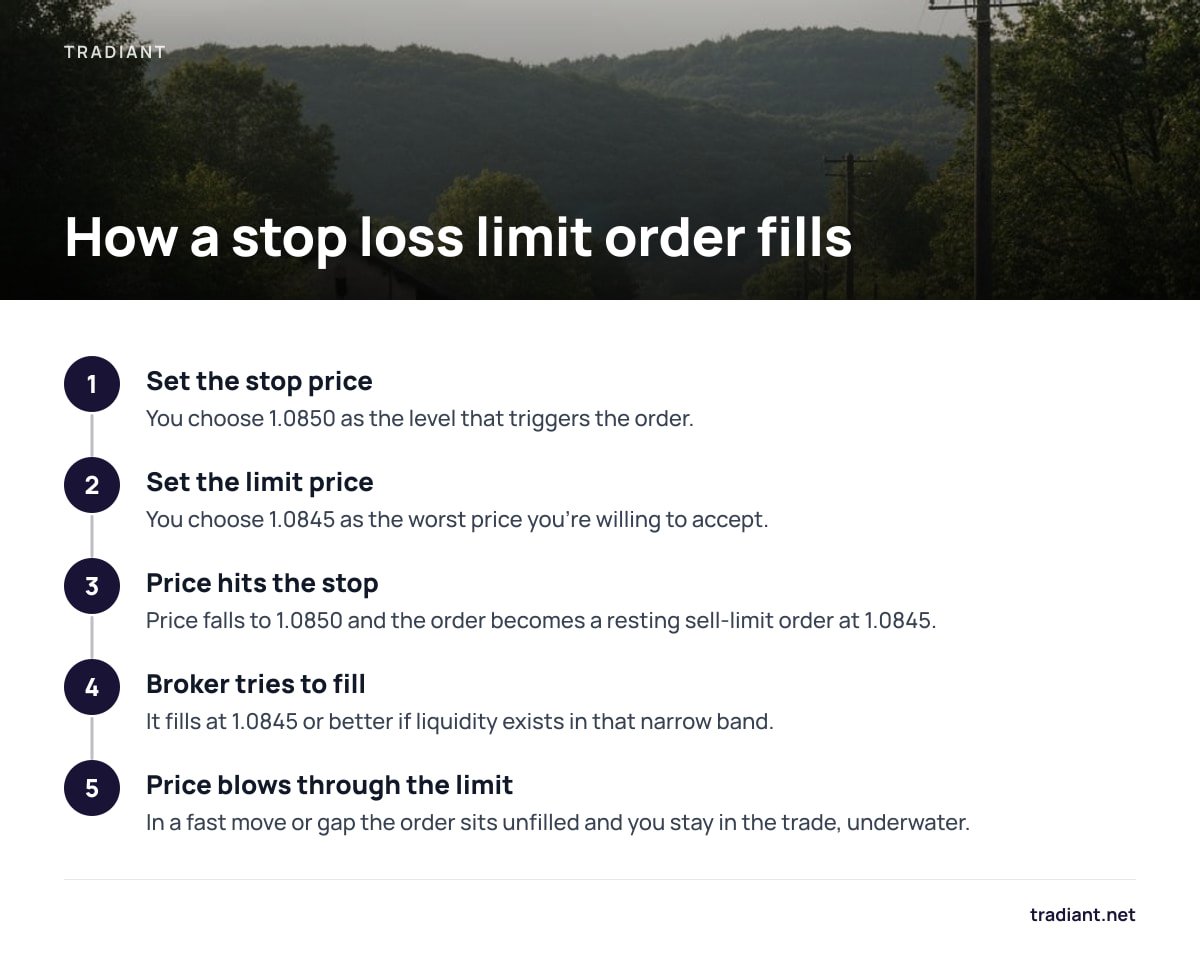
Here's the mechanical sequence, using a long EUR/USD position as the example:
- You set a stop price — say 1.0850 — the level that triggers the order.
- You set a limit price — say 1.0845 — the worst price you're willing to accept.
- Price falls to 1.0850. The order activates and becomes a resting sell-limit order at 1.0845.
- The broker tries to fill it at 1.0845 or better. If liquidity exists in that narrow band, you're out.
- If price blows straight through 1.0845 without pausing — a fast move or a gap — the order sits unfilled, and you're still in the trade, now underwater past where you intended to exit.
That last step is the entire risk of using a stop-limit instead of a plain stop. It's not a flaw in the order type; it's what the order type is designed to do. You asked it to protect your price, not your exit.
Stop Loss vs. Stop-Limit vs. Guaranteed Stop: What Each One Promises
| Order type | Guarantees exit? | Guarantees price? | Typical cost |
|---|---|---|---|
| Stop loss (stop-market) | Yes | No | Usually free |
| Stop loss limit | No | Yes | Usually free |
| Guaranteed stop | Yes | Yes | Premium or spread markup |
A guaranteed stop, offered by some brokers mainly on CFDs, is the only order that promises both an exit and a price — and brokers charge for that certainty because they're the ones absorbing the gap risk. The FCA has written specifically about guaranteed stop losses and gap risk in its retail CFD rules, which is worth reading if you trade instruments prone to overnight gaps, like indices or single stocks, rather than the major forex pairs that trade closer to 24 hours a day.
When a Stop Loss Limit Order Leaves You Stuck in a Losing Trade

Gaps are the scenario stop-limit orders are bad at handling, and gaps cluster around predictable events: scheduled high-impact news releases, central bank decisions, weekend market opens after a Friday close, and the low-liquidity hours around major holidays. If EUR/USD gaps from 1.0850 straight to 1.0790 on a surprise rate decision, a stop-limit order set to fill no worse than 1.0845 simply won't execute. You're still in the position, now 55 pips further from your plan than you budgeted for, waiting for price to either reverse back into your limit or for you to intervene manually.
This is exactly why regulators treat leverage and negative balance protection as separate issues from order types. ESMA's retail CFD rules and most national regulators' negative balance protection requirements exist precisely because stop orders — of any kind — can fail to protect you fully during extreme moves, and someone has to absorb the risk that a client's account goes negative. A stop-limit order doesn't get you that protection on its own; it just shifts where the risk sits.
Pro Tip: Don't set your stop-limit gap as a fixed number of pips across every pair you trade. A 3-pip gap that's reasonable on EUR/USD during London hours is far too tight on a pair like USD/ZAR or on any pair during the Sydney-to-Tokyo overlap, when spreads widen and liquidity thins. Widen the gap in volatile or thinly traded conditions, or switch to a plain stop loss for those sessions specifically.
Setting Your Stop Distance: ATR, Percentage, and Market Structure
Three common ways traders size the distance between entry and stop, and the gap on a stop-limit if they use one:
- Average True Range (ATR). Setting your stop at 1.5x to 2x the 14-period ATR scales the distance to current volatility automatically, so you're not using the same pip count in a quiet market and a volatile one.
- Fixed percentage of account. Risking a flat 1-2% of account equity per trade is simple and common, but it only controls position size — it says nothing about where price structure suggests the trade is actually wrong.
- Structure-based stops. Placing the stop just beyond a recent swing high or low ties your exit to a level the market itself defined, which tends to reduce the number of stops hit by normal noise.
Whichever method you use, the stop-limit gap itself should usually be small relative to your overall stop distance — often 20-30% of it — since a gap that's too wide defeats the purpose of guaranteeing a price at all.
Running Multiple EAs? Why a Single Stop Loss Limit Isn't a Risk Plan

A stop loss, limit or market, only ever protects one trade. If you're running several expert advisors on the same account — which is increasingly common once people move past a single strategy — each EA's per-trade stop can be perfectly sized and you can still blow through your intended account drawdown if three EAs all open correlated positions and all get stopped out the same afternoon. Per-trade risk and account-level risk are different problems with different fixes, and conflating them is one of the most common mistakes covered in our guide on what actually matters before you fund a robot.
The fix isn't a bigger stop-limit gap, it's a separate account-level drawdown limit that sits above all your individual trades and strategies — something that pauses everything once total losses hit a threshold you set, regardless of what any single stop loss did. If you're comparing how different managed or automated services structure that kind of protection against what they charge for it, our breakdown of high-watermark pricing is a useful next read, since fee structure and risk structure usually come as a package.
Get Account-Level Risk Limits Without Building the Spreadsheet Yourself
Setting a stop loss limit on a single trade is the easy part. The harder part — the part most retail traders never get around to — is deciding, in advance and in writing, how much total drawdown the whole account is allowed to take before everything stops trading, and then actually enforcing it when a losing week makes you want to override your own rule. Tradiant runs a rotating squad of trading robots, currently Goldenhawk, on your own broker account with that account-level discipline built in rather than left to you to monitor at 2 a.m.
Accounts start from $500, there's no monthly, setup, or management fee, and the 20% success fee is charged only on new profit above your previous high-water mark — nothing in a losing month. It's not a substitute for understanding how stop orders work on your own trades, and it won't eliminate loss; check the live team sheet and the risk disclosures before funding anything, same as you would with any stop-limit setting.
Frequently Asked Questions
What's the main difference between a stop loss and a stop loss limit order?
A stop loss (stop-market) always executes once triggered, but the fill price isn't guaranteed. A stop loss limit only fills at your chosen limit price or better, which means it can guarantee the price but may not execute at all if the market gaps past that level.
Can a stop loss limit order fail to close my trade?
Yes. If price moves past your limit price in one jump — common during news releases or weekend gaps — the order stays unfilled and the position remains open, often further underwater than you intended.
How wide should the gap be between the stop price and limit price?
There's no universal number, but many traders use 20-30% of their overall stop distance, scaled with volatility measures like ATR. Tighter gaps work on liquid major pairs during active sessions; wider gaps are safer around news events or thinner trading hours.
Is a guaranteed stop the same as a stop loss limit?
No. A guaranteed stop promises both an exit and a specific price, usually for a fee, and brokers only offer it on certain instruments. A stop loss limit promises the price but not the exit, and it's typically free.
Does a stop loss limit protect me if I'm running multiple EAs on one account?
Not fully. Each stop loss limit only protects the single trade it's attached to. If several EAs trade at once, you also need an account-level drawdown limit to cap total losses across all of them combined.
Sources
- Order Types Education | CME Group
- Retail CFD Rules | Financial Conduct Authority
- CFD Investor Protection Measures | European Securities and Markets Authority
- Forex Dealer Member Rules | National Futures Association
