
"Robots for beginners" means automated programs that place forex trades for you — expert advisors, copy-trading bots, or managed robot squads — instead of you watching charts all day. The distinction that matters isn't which one claims the best returns; it's who holds your money and who controls the strategy. A robot you run yourself differs from a copy-trading bot mirroring a stranger's trades, and both differ from a managed service that trades on your own account while you keep custody.
TL;DR:
- Forex robots for beginners fall into three types — EAs you run yourself, copy-trading bots, and managed services — and the type decides who controls your money.
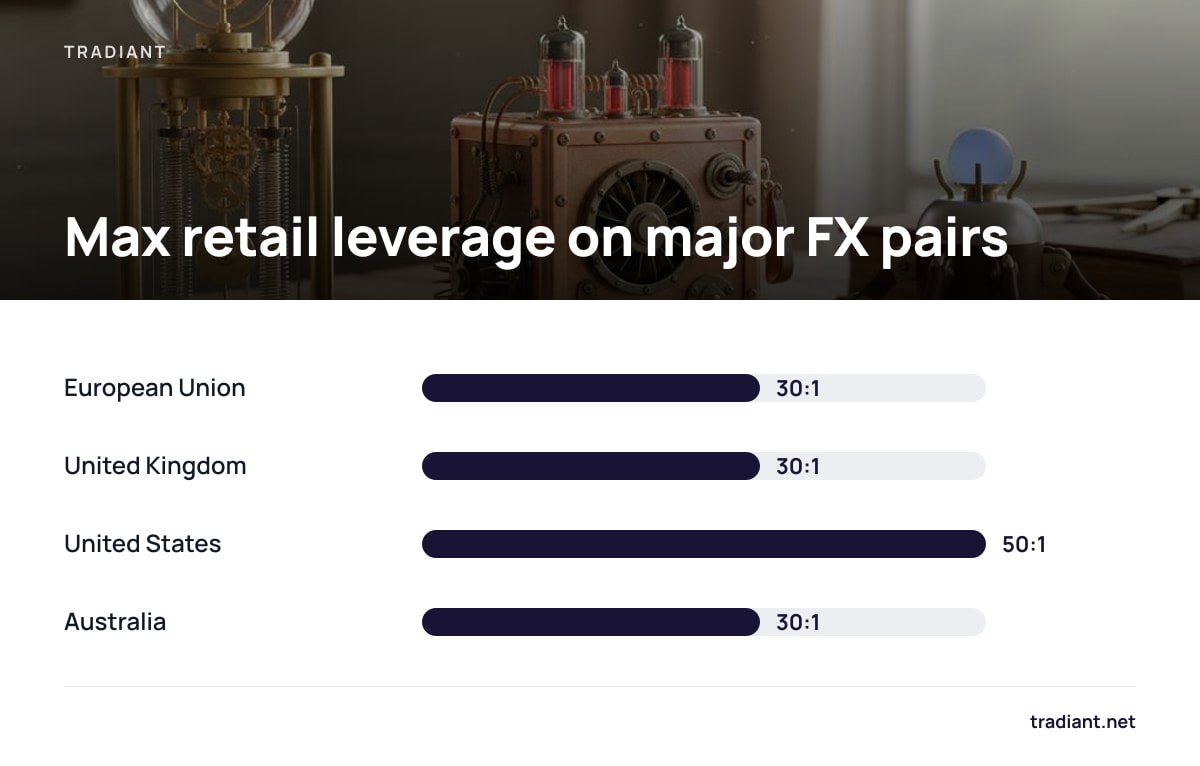
- Regulators cap retail forex leverage differently by region: 30:1 in the EU, UK and Australia, 50:1 in the US.
- Most retail forex accounts lose money; FCA-mandated disclosures put the loss rate at roughly 70-80% across CFD and forex providers.
- A robot's backtest means little until you've seen how it behaves during a volatility spike, not just a calm trend.
- Custody, not performance claims, is the first thing to check — know whether the robot trades on your own broker account or a pooled fund you don't control.
Table of Contents
- The Three Kinds of Robots for Beginners, and Why They're Not Interchangeable
- Where Beginners Actually Lose Money (and It's Rarely the Robot's Fault)
- Leverage Caps by Region: The Math That Decides Your Downside
- Custody: Who Actually Holds Your Money While the Robot Trades
- What a Robot Actually Costs You
- Robots for Beginners: What to Check Before You Fund One
- Get a Managed Robot Squad That Trades on Your Own Account
- Frequently Asked Questions
- Sources
The Three Kinds of Robots for Beginners, and Why They're Not Interchangeable

Every forex robot you'll come across falls into one of three buckets, and mixing them up is where most beginners get surprised. The buckets differ in who writes the strategy, who presses the button, and — most importantly — who holds the money while trades are open.
Expert Advisors (EAs) You Run Yourself
An EA is a piece of code you install on a trading platform, usually MetaTrader, and it executes trades on your own account according to its programmed rules. You buy it once, you host it (on your own computer or a rented virtual server), and you're responsible for keeping it running. Nobody else ever touches your funds, but nobody else is watching it for you either.
Copy-Trading and Signal Bots
These mirror another trader's or system's live positions onto your account, usually through a broker's built-in copy feature or a third-party signal service you subscribe to monthly. You still hold your own funds, but you have far less visibility into why a trade was taken, and the person or robot you're copying can change its risk profile overnight without telling you.
Managed Robot Squads
Here, a company runs one or several robots directly on your broker account under a limited power of attorney, rotating between strategies as market conditions change. You never hand over custody of your money — it stays in your name at your broker — but you also don't touch the strategy decisions day to day. This is the model closest to hiring a manager rather than buying software or following a stranger.
Where Beginners Actually Lose Money (and It's Rarely the Robot's Fault)

The robot usually isn't the problem. The problem is what a beginner does around the robot: doubling position size after a losing week, switching strategies mid-drawdown, or running five uncorrelated bots at once without realizing they're all betting on the same currency move. The FCA requires CFD and forex providers to publish what percentage of their retail client accounts lose money, and that figure has consistently sat in the 70-80% range across the industry — a number that reflects leverage and behavior far more than it reflects any single piece of software.
70-80%. That's the share of retail CFD and forex accounts shown to lose money under FCA-mandated disclosure rules, year after year.
That statistic isn't a reason to avoid automation — it's a reason to be precise about what you're automating. A robot that risks 1% of your account per trade and respects a stop-loss will survive a losing streak. A robot (or a beginner overriding one) that risks 10% per trade will not, regardless of how good the underlying strategy is.
Leverage Caps by Region: The Math That Decides Your Downside
Leverage is the multiplier that turns a small account into a large position, and it's also the fastest way to turn a normal losing trade into an account-wiping one. Regulators in every major market have drawn a hard line on how much leverage a retail client can use, and the line moves depending on where you live.
| Region | Regulator | Max Leverage, Major FX Pairs, Retail Clients |
|---|---|---|
| European Union | National regulators coordinated by ESMA | 30:1 |
| United Kingdom | FCA | 30:1 |
| United States | CFTC / NFA | 50:1 |
| Australia | ASIC | 30:1 |
A US retail trader can technically open a position almost twice the size of an EU or UK trader with the same account balance and the same leverage cap applied. That's not a reason to chase the higher number — it's a reason to size positions well under the cap regardless of which one applies to you.
30:1 versus 50:1. The same $500 account can control nearly double the position size in the US as it can in the EU, UK, or Australia, purely because of where the regulator drew the line.
Custody: Who Actually Holds Your Money While the Robot Trades
This is the single question that matters more than any performance chart. If a service asks you to transfer money into a pooled account, a wallet, or a "fund" it controls, you've handed over custody — your recovery options if something goes wrong depend entirely on that company's honesty and solvency. If the robot trades on your own account at your own regulated broker, your money never leaves your name, and you can pull the plug (or pull the funds) at any moment regardless of what the robot or the company managing it wants.
Pro Tip: Don't judge a robot by its backtest over a calm, trending stretch of months — pull up its behavior (or run it on a demo account) during a week with a scheduled high-volatility event, like a US Non-Farm Payrolls release. Trend-following robots in particular tend to reveal their real drawdown behavior only when volatility spikes without warning, not when the market is doing what the backtest assumed it would.
What a Robot Actually Costs You
Beginners usually compare win rates and skip straight past fee structure, which is a mistake, because fee structure decides whether a mediocre month costs you money twice.
| Model | How You Pay | Typical Cost |
|---|---|---|
| Buy-once EA software | One-time license fee | $50-$500, one time, you host it |
| Copy-trading / signal subscription | Recurring charge regardless of results | $30-$200 per month |
| Managed robot service | Performance fee, usually only on profit | Example: 20% high-watermark fee, nothing charged in losing months |
A subscription you pay in a losing month stings twice. A performance fee structured on a high-watermark — meaning the fee only applies to new profit above your previous peak balance — at least keeps the provider's incentives pointed the same direction as yours.
Robots for Beginners: What to Check Before You Fund One
Before any money moves, run through this list regardless of which type of robot you're considering:
- Who holds custody. Confirm whether funds sit in your name at a regulated broker, or in an account the provider controls.
- What leverage it actually uses. Ask for the real leverage used on open positions, not just the account's maximum allowed leverage.
- How losses are shown, not just wins. Any track record that only highlights winning streaks without showing maximum drawdown isn't a complete track record.
- What the fee structure rewards. A flat monthly fee gets paid whether you win or lose; a performance fee only gets paid when you do.
- Whether you can see what's running. A provider that shows you which strategy is currently active, and which ones are sitting out, is giving you more information than one that just shows a single equity curve.
Get a Managed Robot Squad That Trades on Your Own Account
Tradiant runs a rotating squad of trading robots, currently led by Goldenhawk, directly on your own broker account — never a pooled account, never custody handed over. You start from $500, keep 80% of whatever profit the robot makes, and pay a 20% high-watermark success fee only in months it actually earns you money; losing months cost nothing, and there's no setup or monthly fee on top. A live team sheet shows which robot is active and which are benched, and human live chat plus free booked calls are available 24/7 if you want to ask why.
One honest limit: Tradiant opens in early 2027, so if you're reading this now, use the time to apply the checklist above before the service goes live. There's also a separate buy-once catalogue of self-hosted software tools under the same name, for people who'd rather own and run their own software than pay a performance fee at all.
Frequently Asked Questions
Are forex robots good for beginners specifically, or only for experienced traders?
Beginners can use forex robots, but the type matters more than the fact that it's automated. A self-hosted EA requires you to understand its settings and risk controls, while a managed service that trades on your own account removes that burden but still requires you to understand leverage and custody before you fund it.
Do forex robots guarantee profit?
No legitimate robot or provider can guarantee profit, and regulators including the FCA require loss-rate disclosures precisely because so many retail accounts lose money. Treat any guarantee of returns as a red flag regardless of how the robot is marketed.
What's the minimum amount of money needed to start with a forex robot?
It depends on the provider and broker; some self-hosted EAs can technically run on very small accounts, though higher leverage on a tiny account increases risk of a quick wipeout. Managed services often set a practical minimum, such as $500, partly to keep position sizing sensible relative to the account.
Is a copy-trading bot the same as a managed robot service?
No. A copy-trading bot mirrors another trader's live positions onto your account through a subscription, while a managed robot service runs its own strategy directly on your account under an agreement, typically paid through a performance fee rather than a flat subscription.
How do I check if a forex robot's past performance is real?
Ask for a verified track record from an independent source, such as a broker statement or a recognized trade-verification service, not just a screenshot of an equity curve. Also check the maximum drawdown shown, since a robot's worst month tells you more about risk than its best one does.
Sources
- Product Intervention Measures | European Securities and Markets Authority (ESMA)
- CFD Product Intervention Order | Australian Securities and Investments Commission (ASIC)
- Retail Off-Exchange Forex Rules | Commodity Futures Trading Commission (CFTC)
- National Futures Association | NFA
