
Automated forex trading means software opens, manages and closes currency trades on a broker account by following fixed rules, so nobody has to click buy or sell. The most important question is who controls the money, not which robot you pick. A robot running on an account in your own name, where you can withdraw at any time, carries a very different risk from sending funds to someone else's account. Automation removes fatigue and emotion from trading. It does not remove losses.
TL;DR:
- Automated forex trading is rules-based software placing trades on a broker account. The strategy behind the rules decides results, not the automation.
- Before anything else, check custody. A robot trading an account in your own name, at a regulated broker, keeps withdrawals in your hands.
- With $500 you trade micro lots, where one pip on EUR/USD is worth about $0.10. Risking 1% per trade allows roughly a 50-pip stop.
- Leverage caps depend on where you live. ESMA, the FCA and ASIC cap major pairs at 30:1, and US rules cap them at 50:1.
- Fee structure shapes behavior. A high-watermark success fee only pays the provider for new profit, while monthly fees get charged whether the robot wins or loses.
Table of Contents
- How Automated Forex Trading Works, From Signal to Filled Order
- Three Ways to Run a Robot, and Who Holds Your Money in Each
- What $500 Actually Buys You in Position Size
- Leverage Limits by Region, and Why Your Location Changes the Math
- Where Automated Trading Goes Wrong, and the Warning Signs of a Bad Robot
- What Automated Forex Trading Costs Beyond the Deposit
- Getting Started: Five Checks Before You Fund Anything
- Get Hands-Off Forex From $500 Without Handing Over Your Money
- Frequently Asked Questions
- Sources
How Automated Forex Trading Works, From Signal to Filled Order
An automated forex system is a set of trading rules turned into code. Once it's running, it watches price data, decides when the conditions for a trade are met, sends the order to your broker, and manages the position until it closes. You don't need to be awake, and you don't get the chance to second-guess it.
Every working setup has four parts. If one is weak, the whole system is weak.
- The strategy rules. This is the playbook. A trend-following robot buys when price breaks out and holds while the move continues. A mean-reversion robot does the opposite and bets that stretched prices snap back. The rules decide your results. The automation just carries them out.
- The execution engine. This is the code that turns a signal into an actual order: market or pending, what size, and with what stop. Badly written execution can turn a good strategy into a losing one through late entries and slippage.
- The risk module. These are the hard limits, such as maximum position size, a stop-loss on every trade, and a daily or total drawdown at which the robot stops. If your robot has no risk module, it's gambling on a schedule.
- The hosting. Forex trades around the clock from Sunday evening to Friday evening. A robot running on your laptop stops when the lid closes, so serious setups run on a server that stays connected.
Think of it like a team with a fixed game plan. The robot plays the same way every match, which is its strength when the plan suits the conditions and its weakness when it doesn't. A trend-follower is a counterattacking side. It thrives when the game opens up and bleeds points in a scrappy midfield grind, which in market terms means a choppy, sideways market.
Three Ways to Run a Robot, and Who Holds Your Money in Each
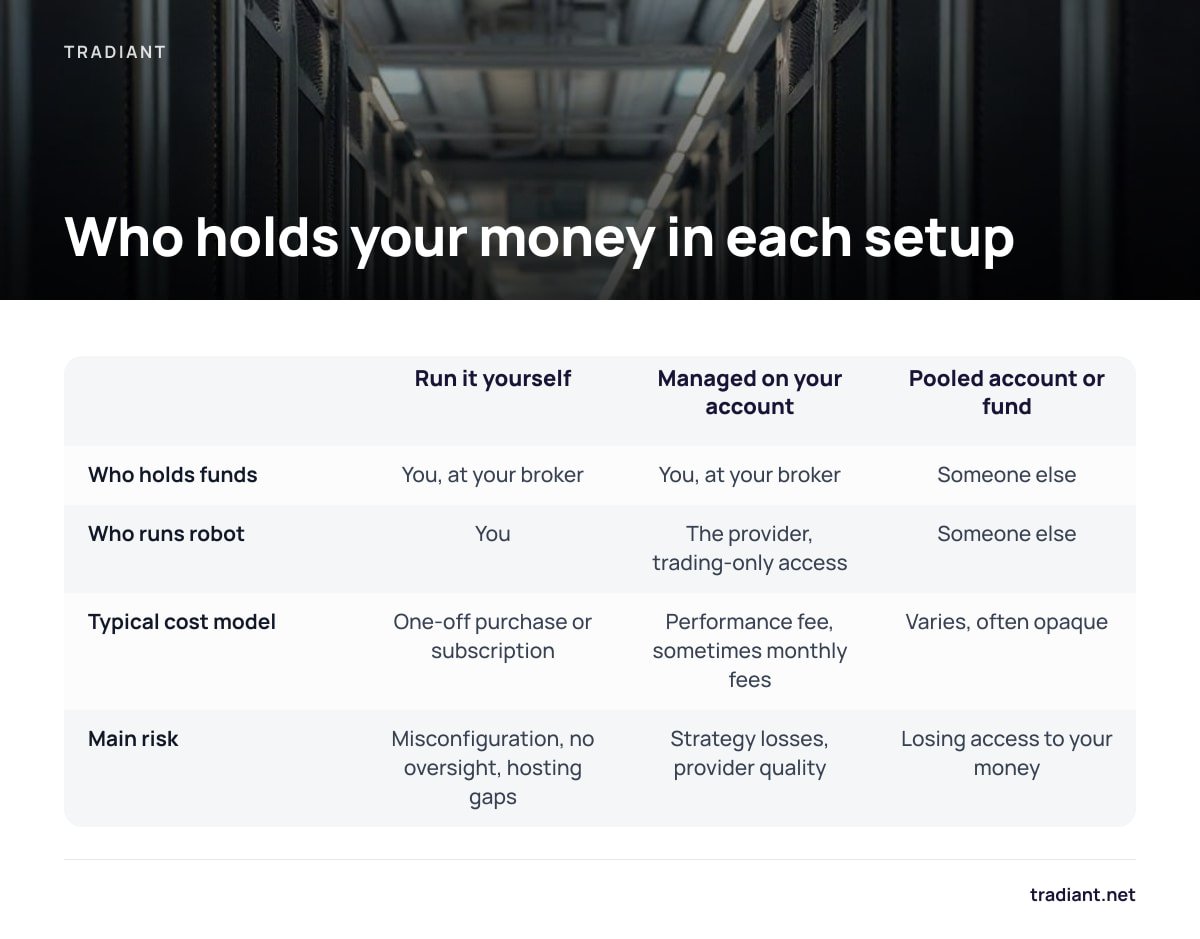
Most beginners compare robots on advertised returns. The more useful comparison is how each arrangement handles custody, control and cost.
| Setup | Who holds your funds | Who runs the robot | Typical cost model | Main risk |
|---|---|---|---|---|
| Buy a robot and run it yourself | You, at your broker | You | One-off purchase or subscription | Misconfiguration, no oversight, hosting gaps |
| Managed robot on your own account | You, at your broker | The provider, with trading-only access | Performance fee, sometimes monthly fees | Strategy losses, provider quality |
| Send money to a pooled account or "fund" | Someone else | Someone else | Varies, often opaque | Losing access to your money entirely |
If you're a beginner, I'd pick the middle row. Running a robot yourself sounds cheaper. In practice you take on the setup, the server, the updates and the decision about when to switch the robot off, and that's a lot of homework for someone who wanted something hands-off. The bottom row is where most forex fraud sits. If a provider needs your money in their account for the robot to work, walk away.
With a managed arrangement on your own account, the provider typically gets trading permissions but not withdrawal rights. The money sits with a broker you chose, under a regulator you can check, and you can withdraw or revoke access whenever you like.
What $500 Actually Buys You in Position Size
Minimum deposits only make sense once you translate them into trade size. Forex is traded in lots. A standard lot is 100,000 units of the base currency, a mini lot is 10,000, and a micro lot (0.01) is 1,000.
| Lot size | Units | Value of one pip on EUR/USD | Pips a 1% risk covers on $500 |
|---|---|---|---|
| Standard (1.00) | 100,000 | ~$10.00 | 0.5 pips |
| Mini (0.10) | 10,000 | ~$1.00 | 5 pips |
| Micro (0.01) | 1,000 | ~$0.10 | 50 pips |
At 0.01 lots on EUR/USD, one pip is worth about $0.10. A $500 account risking 1% per trade can afford a 50-pip stop and no more.
This is why $500 is a realistic floor rather than an arbitrary number. Trend-following strategies often need stops of 50 pips or more to survive normal price noise. Below about $500, a robot either takes on more risk per trade than is sensible or can't place the trade at all, because most brokers' minimum size is 0.01 lots.
On a $500 account, sensible results look small in dollars. A good month might be $15 to $40. If someone shows you a $500 account doubling in a month, that robot is taking risks that will eventually show up as a large loss.
Pro Tip: Ask any robot provider what its largest historical drawdown was in percentage terms, then convert it to dollars on your own deposit. A 25% drawdown on $500 is $125. If watching $125 disappear over a few bad weeks would make you pull the plug, you'll switch the robot off at the bottom and lock in the loss. That's the most common way beginners lose money with a strategy that later recovers.
Leverage Limits by Region, and Why Your Location Changes the Math
Leverage lets a small deposit control a larger position. With 30:1 leverage, a micro lot of EUR/USD worth roughly $1,100 needs only about $35 to $40 of margin. How much leverage you can access depends on where your broker is regulated, not on the robot.
- European Union. ESMA's product intervention measures introduced in 2018 cap retail leverage at 30:1 on major currency pairs and 20:1 on non-majors. They also require negative balance protection, so a retail client can't lose more than their deposit, and a margin close-out rule at 50% of required margin. National regulators across the EU have since adopted these measures permanently.
- United Kingdom. The Financial Conduct Authority applies equivalent rules: 30:1 on majors, negative balance protection, and a requirement that firms disclose what percentage of their retail accounts lose money.
- United States. Retail forex is capped at 50:1 on major pairs and 20:1 on others under CFTC rules. Dealers must be registered with the National Futures Association.
- Australia. ASIC has capped retail leverage at 30:1 on major currency pairs through its product intervention order on CFDs.
- Japan. Retail forex leverage is capped at 25:1.
When ESMA introduced its restrictions, it reported that between 74% and 89% of retail CFD accounts typically lost money.
That figure is worth keeping in mind. Lower leverage limits are a form of protection, not an obstacle. A well-built robot running on a $500 account should never need anything close to the maximum leverage available. If it does, the robot is oversized.
Where Automated Trading Goes Wrong, and the Warning Signs of a Bad Robot
Automation doesn't fail in mysterious ways. The failures are predictable, and most of them show up before you deposit anything.
Curve-fitted backtests
Software can be tuned until it would have made perfect trades on historical data. That's called overfitting, and the result has learned the past rather than a strategy. Be wary of backtests with very smooth equity curves, few losing months, or results that rely on one specific time period. Ask for live, verified trading history instead.
Martingale and grid systems
Some robots double their position after every loss, or keep adding trades as price moves against them. Their track records look excellent for months because small wins keep piling up, until one sustained move wipes out the account. If a robot's results show almost no losing trades, find out how it handles a losing position.
No stop-loss, or the wrong kind
Every trade should have a defined exit. How that exit is placed matters too. A stop-limit order may not fill at all in a fast market, which is covered in our guide to the stop loss limit distinction.
Promises that sound like fraud
The CFTC has repeatedly warned consumers that claims of guaranteed or outsized returns from trading bots, including bots marketed as AI-powered, are a common hook in forex fraud. Any promise of a fixed monthly return is a red flag on its own, because no legitimate trading strategy can guarantee one.
Market regime change
Even a good robot has bad seasons. A trend-follower struggles in sideways markets, and a range-trader gets hurt when a strong trend begins. This isn't a defect. It's the cost of having a defined approach. Our guide on what matters before you fund a robot covers how to tell a normal losing stretch from a broken strategy.
What Automated Forex Trading Costs Beyond the Deposit
Your deposit is trading capital, not a fee. The costs come from three places, and beginners tend to underestimate all of them.
- Trading costs. Every trade pays the spread, and some account types add a commission. A robot that trades often on a wide-spread account gives away much of its edge before the market even moves.
- Software or service fees. These can be a one-off purchase, a monthly subscription, a setup charge, a performance fee, or a mix of these.
- Hosting. If you run a robot yourself, you'll usually pay a monthly fee for a server that keeps it online.
Monthly fees hit small accounts hard. A $30 monthly subscription on a $500 account is 6% a month that the robot has to earn before you make anything, and you pay it in losing months too. Performance fees with a high-watermark line up the provider's incentives with yours.
Here's how a high watermark works, ignoring the fee itself for simplicity. Your $500 grows to $600, so the provider earns 20% of the $100 profit, which is $20. The next month the account drops to $550, and you pay nothing. The month after, it climbs to $620. You pay only on the $20 above the previous peak of $600, not on the recovery from $550. The provider never gets paid twice for the same gains. For the full mechanics, see how high-watermark pricing works.
Getting Started: Five Checks Before You Fund Anything
- Verify the broker yourself. Search the broker's name on the regulator's own register: the FCA Financial Services Register in the UK, NFA BASIC in the US, ASIC's professional register in Australia, or your national regulator in the EU. Don't rely on a logo on the broker's website.
- Confirm the account is in your name. You should be able to log in independently, see every trade, and withdraw without asking anyone.
- Set your drawdown limit before day one. Decide the percentage loss at which you'd stop, write it down, and make sure the robot or service has a matching limit.
- Know where the off-switch is. You should know how to revoke trading access or close positions yourself within a few minutes.
- Judge results quarterly, not daily. A robot's edge shows up across dozens of trades. Checking every hour turns a hands-off product into a stressful one.
Get Hands-Off Forex From $500 Without Handing Over Your Money
Tradiant is built around the problems this article has described. The robots trade on your own broker account, so custody stays with you. The minimum is $500, sized for micro-lot risk control. There are no monthly, setup or management fees. You keep 80% of profits, and a 20% high-watermark success fee applies only to new peaks, so you pay nothing in losing months. The current robot in the squad is Goldenhawk, a trend-follower. A live team sheet shows which robots are active and which are benched, and human support is available around the clock on live chat or through free booked calls.
There are two honest caveats. First, the service opens in early 2027, so you can't fund it today. Second, Goldenhawk is a trend-follower, so it will have flat or losing stretches in sideways markets. Before you commit, read the drawdown figures on the spec sheet, including ours.
Frequently Asked Questions
Is automated forex trading profitable for beginners?
It can be, but profitability depends on the strategy the robot follows, not on the fact that it's automated. Plenty of robots lose money, and regulators report that most retail leveraged-trading accounts lose money overall. Look for verified live results, a defined maximum drawdown, and fees that only apply when you profit.
What is the minimum deposit for automated forex trading?
Many brokers technically accept less, but around $500 is a practical floor. At that size, a robot trading 0.01 lots and risking 1% per trade can use a stop of about 50 pips on EUR/USD. Smaller accounts force either excessive risk per trade or stops too tight to survive normal price movement.
Can a forex robot lose more than my deposit?
In the EU, the UK and Australia, regulators require brokers to give retail clients negative balance protection, so losses are limited to the money in the account. In other jurisdictions the protection varies by broker, so check your broker's terms. A robot with proper stop-losses and a drawdown limit should also stop trading well before the account reaches zero.
Is automated forex trading legal?
Yes, using automated software to trade your own account is legal in the US, the UK, the EU, Australia and most other major markets. What's regulated is the broker, and in some regions anyone managing money for others. Always confirm your broker appears on its regulator's official register.
Do I need to keep my computer on for a forex robot to work?
If you run the robot yourself, yes. In practice that means renting a server that stays online around the clock while the market is open. With a managed service, the provider handles hosting, and you only need access to your broker account to monitor trades.
Sources
- Product intervention measures on CFDs and binary options | European Securities and Markets Authority
- CFD rules and consumer protection for retail clients | Financial Conduct Authority
- Retail forex registration and BASIC member lookup | National Futures Association
- Learn and Protect: customer advisories on fraud | Commodity Futures Trading Commission
- Product intervention order on CFDs | Australian Securities and Investments Commission
Recommended
- Stop Loss Limit: The Distinction That Decides If You Get Filled
- No Monthly Fee Managed Forex: How High-Watermark Pricing Works
- Robots for Beginners: What Actually Matters Before You Fund One
- Minimum Deposit Forex Broker: What You Can Really Start With
- How to Withdraw Forex Trading Funds From a $500 Account
- Best Account Type for Beginners: Fund Your First $500 Right
