
Drawdown explained simply: it is the drop from an account's highest value to its lowest point afterward, before a new high is reached. It measures how far you fell, not whether you lost money overall. In trading, the number that matters most is maximum drawdown, because recovering from a loss takes a bigger gain than the loss itself, and that gap grows fast.
TL;DR:
- Drawdown is the percentage fall from a peak to the next trough, measured before a new peak is set.
- Recovery math is lopsided: a 50% drawdown needs a 100% gain to get back to even.
- Banking, pension, and construction use "drawdown" to mean withdrawing money, which is a different thing entirely.
- Maximum drawdown is only a worst case so far, not a ceiling, so set your own hard limit in advance.
- A tolerable drawdown is one you would sit through without switching the strategy off at the bottom.
Table of Contents
- What Drawdown Means in Simple Terms
- How a Drawdown Works, Step by Step
- What a 50% Drawdown Means (and Why Recovery Math Is Brutal)
- Drawdown in Trading and Forex
- Drawdown in Banking, Loans, Pensions, and Construction
- How Much Drawdown Is Too Much?
- How to Limit Drawdown in Practice
- Get Drawdown Rules Enforced Before You Need Them
- Frequently Asked Questions
- Sources
What Drawdown Means in Simple Terms
A drawdown is a decline from a peak. Your account hits $10,000, slides to $8,500, and starts climbing again. The drawdown was $1,500, or 15%. It lasts until the account makes a new high above $10,000.
Think of a runner's lap times. Your total race result tells you where you finished. The drawdown tells you how badly you faded in the middle. Two strategies can both end the year up 20%, and one can get there with a 6% worst dip while the other had a 35% dip. Same finish, very different ride.
Drawdown is measured against the peak, not against what you deposited. That is why you can be up overall and still be "in drawdown." It also means a drawdown is a statement about the path, not the destination.
How a Drawdown Works, Step by Step

The mechanics are simple. You track three things: the peak, the trough, and the recovery.
- Peak. The highest account value reached so far. Traders call this the high-water mark.
- Trough. The lowest value reached after that peak.
- Recovery. The point where the account climbs back above the old peak, which ends the drawdown.
The formula is: (peak minus trough) divided by peak. If your peak is $4,000 and the trough is $3,000, the drawdown is 25%.
Two versions get mixed up constantly:
| Measure | What it tracks | Why it matters |
|---|---|---|
| Current drawdown | Distance below the latest peak right now | Tells you how deep you are today |
| Maximum drawdown (MDD) | The largest peak-to-trough drop in a whole period | Tells you the worst stretch you would have lived through |
| Balance drawdown | Based on closed trades only | Can hide losses still floating |
| Equity drawdown | Includes open, unrealized positions | The honest number; it is what your margin sees |
If a tool shows you only balance drawdown, it can look calm while open trades quietly bleed. For anything involving leverage, equity drawdown is the one to trust.
What a 50% Drawdown Means (and Why Recovery Math Is Brutal)

A 50% drawdown means your account lost half its value from the peak. A $10,000 account is now $5,000. That sounds like it needs a 50% gain to fix. It does not.
From $5,000, a 50% gain gets you to $7,500. To return to $10,000, you need to double the account, a 100% gain.
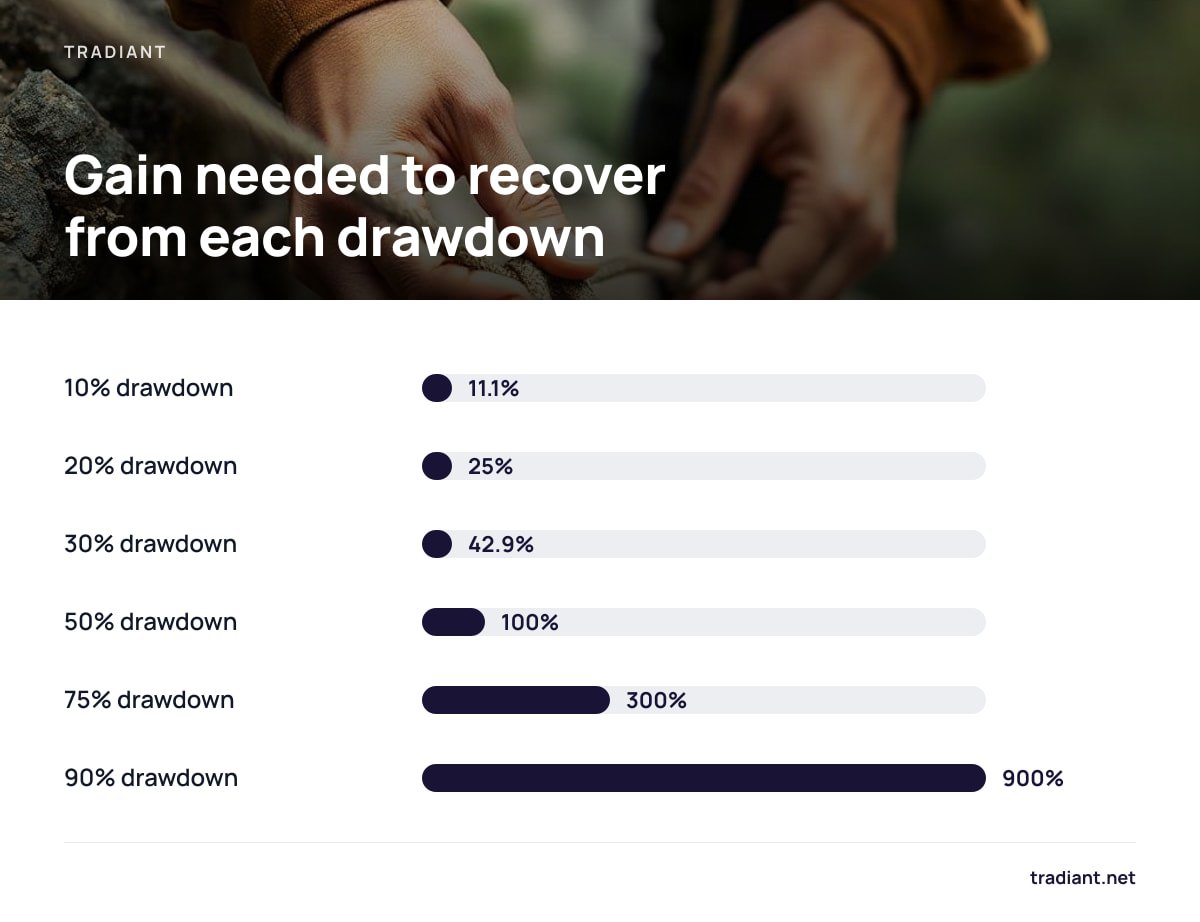
A 50% drawdown needs a 100% gain to recover. A 90% drawdown needs 900%.
Here is the full picture:
| Drawdown | Gain needed to break even |
|---|---|
| 10% | 11.1% |
| 20% | 25% |
| 30% | 42.9% |
| 50% | 100% |
| 75% | 300% |
| 90% | 900% |
The curve bends upward hard past 30%. This is the single best reason to treat drawdown as a risk budget rather than a statistic you glance at afterward. Losses compound against you, and gains must compound back just to repair the damage.
Pro Tip: Judge a strategy by its recovery time as well as its depth. A 15% drawdown that heals in six weeks is far easier to live with than a 15% drawdown that lingers for fourteen months. Most people abandon a strategy during a long, flat underwater stretch, not at the moment of the deepest dip. Ask for the longest time between two equity highs.
Drawdown in Trading and Forex
In trading, drawdown is the standard way to describe pain. Return tells you what a strategy earned. Drawdown tells you what it cost you emotionally and financially to earn it.
In forex, three things push drawdown higher than people expect:
- Leverage. A small adverse move on a leveraged position becomes a large percentage of account equity.
- Open positions. Floating losses count toward equity drawdown even before you close anything.
- Correlation. Several trades on currency pairs that share a currency, say EUR/USD and GBP/USD, often lose together, so "diversified" positions can behave like one big bet.
Trend-following systems deserve a specific note. They tend to lose small, often, and then make it back in a few big moves. That shape guarantees stretches of drawdown. A trend follower with no drawdown would be suspicious, not impressive. If you are weighing how much account loss you can tolerate before pulling the plug, our piece on stop loss limits covers how exits actually get filled when the market gaps.
Running several robots at once changes the math too, because their drawdowns can overlap. That is covered in running robots together, and it is where many beginners get surprised.
Drawdown in Banking, Loans, Pensions, and Construction
Here is where the same word means something different, and where the obvious answer is wrong. Outside of trading, "drawdown" usually means taking money out, not losing it.
Loans and banking
A drawdown is the act of pulling funds from an approved credit facility. If a bank approves a $200,000 line, you might draw down $50,000 now and the rest later. A drawdown notice (or drawdown request) is the formal request you send to the lender asking for that money. The drawdown amount is simply the sum requested in that notice. You pay interest only on what you have drawn, which is the whole appeal.
Pensions
Pension drawdown means taking income from your retirement pot while the remainder stays invested. The risk is the same idea as the trading one in disguise: if markets fall right after you start withdrawing, you sell units at low prices and the pot may not recover. Retirement planners call this sequence-of-returns risk.
Construction
In construction finance, a drawdown is a staged payment release from a construction loan as work reaches milestones: foundation, framing, completion. Lenders usually inspect progress before each release.
The practical rule: when you see "drawdown," check whether money is leaving an account on purpose (a withdrawal) or shrinking by accident (a loss). They sound alike and are opposites in intent.
How Much Drawdown Is Too Much?
There is no universal number, but there are useful anchors.
- Under 10%: conservative. Common for diversified, low-leverage approaches.
- 10% to 25%: typical for active retail strategies. Uncomfortable but survivable.
- 25% to 40%: aggressive. Recovery needs 33% to 67% gains, and most people bail out.
- Over 50%: account-threatening. At this level the strategy usually needs a miracle, not a plan.
My position: for a beginner funding an account with $500 to a few thousand dollars, cap your tolerance near 20%. At 20% you need a 25% gain to recover, which is realistic. At 40% you need 67%, which turns "patient" into "hoping."
Two honest caveats. First, a backtest's maximum drawdown is the worst case so far, not the worst case possible. Treat the next real drawdown as likely to exceed the historical one. Second, a stated drawdown limit is a promise only if something enforces it. A number you write on a sticky note and a rule your broker account actually applies are very different things.
How to Limit Drawdown in Practice
You cannot eliminate drawdown. You can shape it.
- Size positions small. Risking 1% of equity per trade means ten straight losses cost roughly 10%, not a wipeout.
- Use hard stops. Place stop losses at order entry rather than relying on willpower mid-trade.
- Set an account-level kill switch. Decide in advance that at a 20% equity drop, everything pauses for review.
- Avoid stacking correlated trades. Count a shared currency as one exposure, not three.
- Track equity, not balance. Floating losses are real.
If you would rather have someone else enforce these rules, the trade-offs between custody models and fees are laid out in our forex managed account comparison. And if you have ever been tempted by a leaderboard of impressive returns, read what the leaderboard won't tell you first; it rarely shows drawdown prominently.
Get Drawdown Rules Enforced Before You Need Them
Knowing the math is the easy part. Sticking to it while an account is falling is where most people fail. Tradiant runs an automated forex service on your own broker account, with a rotating squad of trading robots (currently Goldenhawk, a trend follower), so the position sizing and exits are rule-based rather than decided in the heat of a bad week. You keep custody of your money, you see which robots are active or benched on a live team sheet, and a human is on live chat if you want to talk it through.
Pricing is built so the fee only exists when you are ahead: you start from $500, keep 80% of profits, and pay a 20% success fee measured against your high-water mark, with nothing charged in a losing month. That means you never pay twice for recovering the same ground. The honest caveat: Tradiant opens in early 2027, and no robot removes drawdown. Trend followers in particular go through underwater stretches, so expect them and read the risk disclosures before funding anything.
Frequently Asked Questions
What does "drawdown" mean in simple terms?
A drawdown is how far something falls from its highest point to its lowest point afterward. It is usually shown as a percentage of the peak. In trading it measures a loss streak; in banking it means withdrawing approved funds.
How does a drawdown work?
You record the peak value, wait for the account to fall, and note the lowest point reached before a new high. The drawdown is the peak minus that trough, divided by the peak. It ends only when the account makes a new high above the old peak.
What does 50% drawdown mean?
It means the account lost half its value from the peak, for example $10,000 down to $5,000. Getting back requires a 100% gain, not 50%, because you are growing from a smaller base. That asymmetry is why large drawdowns are so hard to repair.
What is meant by drawdown in trading?
In trading, drawdown is the decline in account equity from a peak to a subsequent trough. Maximum drawdown is the largest such decline over a period and is the standard measure of a strategy's worst stretch. Equity drawdown, which includes open positions, is more honest than balance drawdown.
What is a drawdown notice?
A drawdown notice is a formal request to a lender to release funds from an approved loan or credit facility. It states the amount you want and often the date. The lender then checks conditions before paying out.
Sources
- Maximum Drawdown (MDD) | Investopedia
- Drawdown | Investopedia
- Leveraged forex trading risk | Commodity Futures Trading Commission
- Retail forex investor information | National Futures Association
- Pension drawdown | MoneyHelper (UK government-backed)
