
A martingale forex EA is a trading robot that increases its position size after every losing trade, so one eventual winner recovers all earlier losses plus a small profit. The distinction that matters is that this works on paper with unlimited capital, but a real account has a margin ceiling. The strategy swaps many tiny wins for a rare loss big enough to end the account.
TL;DR:
- A martingale EA adds size after each loss; its equity curve looks smooth right up until the one trend it can't outlast.
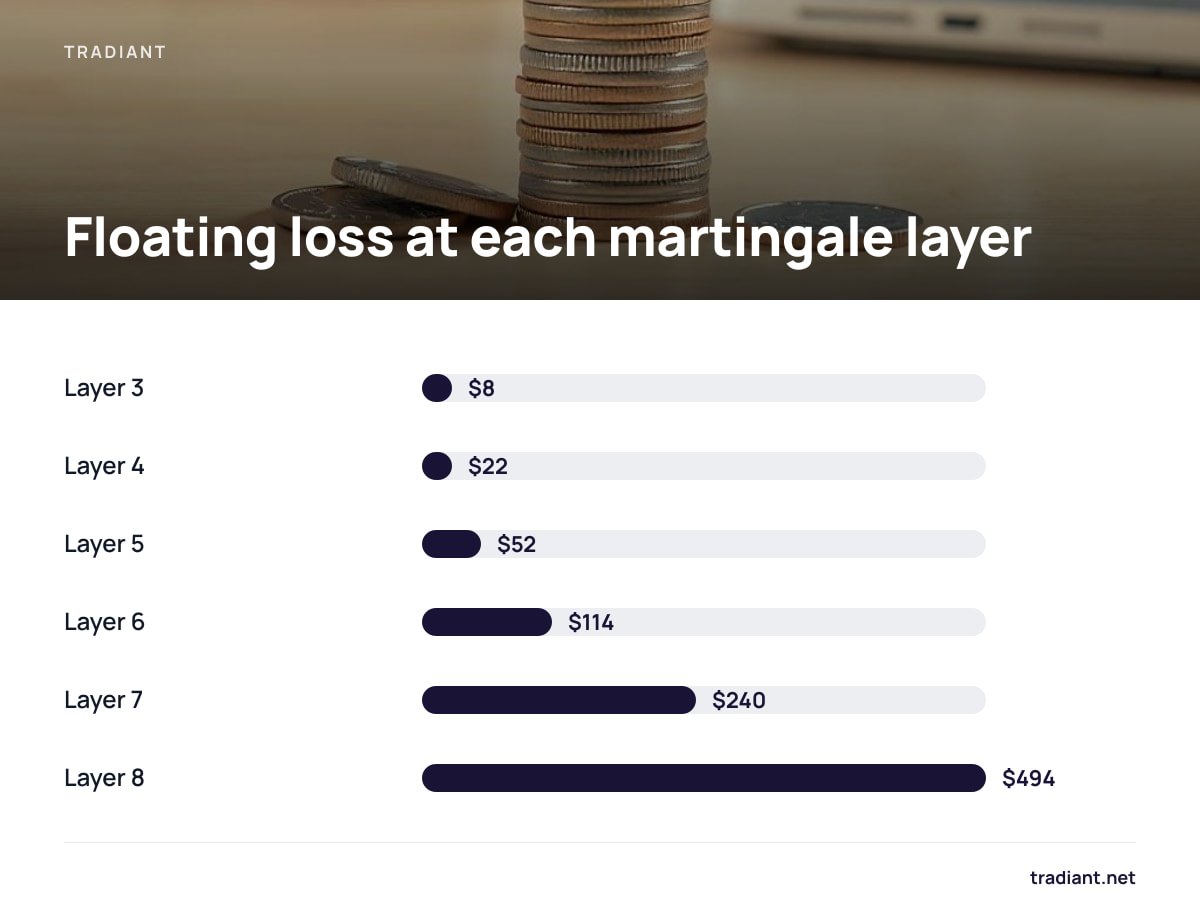
- With a 0.01-lot start, 2x multiplier and 20-pip spacing, layer 8 holds 2.55 lots and floats about $494 in losses.
- On a $500 account at 30:1 leverage, margin alone reaches roughly $500 by the fourth layer, so there's no room to recover.
- Hedging variants delay the pain rather than remove it, and US retail accounts don't allow hedging at all.
- A trend-following robot fails in the opposite, survivable way: many small capped losses, not one large uncapped one.
Table of Contents
- How a Martingale Forex EA Trades, Layer by Layer
- The Math a $500 Account Can't Survive
- Why Backtests and Forum Screenshots Make Martingale Look Brilliant
- Hedging Martingale and Grid Variants: What Changes, What Doesn't
- Free Martingale EA Downloads: What to Check Before You Attach One
- Martingale vs. Trend-Following: Which Failure Would You Rather Live With?
- If You Still Want a Martingale EA, Here Are the Guardrails
- Get a Trend-Following Robot Without the Blowup Risk
- Frequently Asked Questions
- Sources
How a Martingale Forex EA Trades, Layer by Layer
The idea predates forex by centuries. Gamblers doubled their bet after each loss so the first win would erase everything. An EA ports that logic to price charts. It opens a small trade, and if price moves against it by a set distance, it opens another trade in the same direction, larger than the last. It repeats until the whole basket can close in profit, usually a few pips above the average entry.
Most commercial and free versions share the same dials:
- Starting lot. The size of the first trade, often 0.01 on a standard account.
- Multiplier. How much each new layer grows. Classic martingale uses 2.0. Gentler "grid" versions use 1.3 to 1.6.
- Step distance. How many pips price must move against you before the next layer opens.
- Basket take-profit. The profit target for the whole stack, not for any single trade.
- Max layers. The cap, if the author included one. Many don't, or set it so high it never triggers before the broker closes you out.
If you want the broader picture of how expert advisors are built and where they break, our Forex EA explainer covers the basics. Here, the focus is the one design choice that changes the risk profile completely.
The Math a $500 Account Can't Survive

Let's run a plain example on EUR/USD: 0.01 lot start, 2.0 multiplier, 20-pip steps, USD account, roughly $10 per pip per full lot. Floating loss is measured at the moment each new layer opens.
| Layer | Lot size | Total lots | Approx. margin at 30:1 | Floating loss when it opens |
|---|---|---|---|---|
| 1 | 0.01 | 0.01 | $33 | $0 |
| 2 | 0.02 | 0.03 | $100 | $2 |
| 3 | 0.04 | 0.07 | $233 | $8 |
| 4 | 0.08 | 0.15 | $500 | $22 |
| 5 | 0.16 | 0.31 | $1,033 | $52 |
| 6 | 0.32 | 0.63 | $2,100 | $114 |
| 7 | 0.64 | 1.27 | $4,233 | $240 |
| 8 | 1.28 | 2.55 | $8,500 | $494 |
Margin figures are approximations that treat a full lot as needing about $3,333 at 30:1; the real number moves with the EUR/USD rate and your broker.
The cycle that ends at layer 1 earns about $2. The cycle that reaches layer 8 has $494 floating against you and needs 2.55 lots of margin.
Two things jump out. First, the account that "survives" depends entirely on size. A $500 balance is out of margin around layer 4, after a move of only about 60 pips, which EUR/USD can cover in a single news session. Second, the loss grows faster than the pips do. Doubling the pips from 60 to 120 multiplies the floating loss by more than ten.
A coin-flip comparison makes the trap clearer. Eight losses in a row at 50/50 happens about 1 time in 256. But currency pairs trend, and losses cluster. A martingale EA is effectively betting that no trend will ever run long enough, which is the same as betting against the market's most reliable behavior.
Why Backtests and Forum Screenshots Make Martingale Look Brilliant

You've probably seen the screenshots: a near-straight equity line, a 90% win rate, a four-digit percentage return. Those are real in the way a team's record is real when it hasn't yet played its toughest opponent.
A martingale strategy wins most of the time by construction. Almost every cycle closes with a small profit, so any test window that doesn't include a prolonged one-directional move shows a gorgeous curve. The loss event is rare, which means a six-month backtest can easily miss it.
Watch for these tells:
- Closed-trade drawdown only. The report shows realized losses, not the floating loss on open baskets. Look for equity drawdown, not balance drawdown.
- Short test windows. A year of data on one pair proves little. You want multiple years including a few strong trends.
- Lot size creeping up in the deal list. If the largest position in the report is more than ten times the starting lot, you're looking at a martingale whatever the sales page calls it.
- Perfect forward results on a demo. Demo accounts don't show real slippage, widened spreads, or the stop-out that happens when liquidity thins out.
Our guide to scam red flags goes through the other presentation tricks that make a fragile system look robust.
Hedging Martingale and Grid Variants: What Changes, What Doesn't
The most searched variant is the hedging martingale. Instead of only averaging into a losing direction, it opens an opposite-direction position at some trigger, locking part of the floating loss, and then manages both sides until the basket can be unwound.
The appeal is real. A hedge freezes the dollar loss while you wait. The problem is that you have not removed the risk, only moved it. You now hold two sides, pay spread and swap on both, and still have to pick the moment to lift the hedge, which means being right about direction anyway.
Your regulator may also decide this for you:
- United States. NFA rules for retail forex dealers require first-in, first-out closing and prohibit holding offsetting long and short positions in the same pair within one account. A hedging EA can't run as designed there.
- Europe. ESMA's product intervention measures set retail leverage at 30:1 on major pairs, a 50% margin close-out rule, and negative balance protection. That leverage cap is exactly why the table above runs out of room so early.
- Australia. ASIC's product intervention order also caps retail leverage on major pairs at 30:1.
- Platform type. MetaTrader 5 offers both netting and hedging account modes. On a netting account, you get one net position per symbol, so a hedge-based EA simply won't behave as advertised.
The practical takeaway: before downloading anything, check what account type and jurisdiction your broker offers. Many hedging EAs only work on accounts that some of our readers can't legally open.
Free Martingale EA Downloads: What to Check Before You Attach One
Free versions are everywhere, and "free" is not automatically a problem. The code for a simple martingale is a weekend project, and open-source repositories contain honest ones. The risk is that you can't tell which is which.
Work through this before any file touches a live account:
- Get the source file. A
.mq4or.mq5file can be read; a compiled.ex4or.ex5file cannot. If you can't see the code, you can't see the multiplier or the layer cap. - Search for the cap. Look for a maximum-layers input and a hard equity stop. No cap means the EA will keep adding size until the broker stops it.
- Check for external calls. Any request to an outside server or an unexplained DLL import is a reason to walk away.
- Run it on a demo through a volatile week. Include a central bank meeting and the Friday close.
- Test with the smallest size possible. A cent account or the broker's minimum lot, with money you'd happily lose.
Pro Tip: Open the deal list from a strategy report and sort by volume, descending. Divide the biggest lot by the first lot of that same cycle. If it's above 8 or 10, the EA is scaling into losers no matter what the listing calls it ("recovery," "smart grid," "adaptive averaging"). Then multiply that largest lot by your broker's margin per lot and compare it to your balance.
Martingale vs. Trend-Following: Which Failure Would You Rather Live With?
Every strategy loses somewhere. What matters is the shape of the loss.
| Martingale EA | Trend-following EA | |
|---|---|---|
| Win rate | Very high | Typically under 50% |
| Size of a typical win | Tiny | Larger than the typical loss |
| Size of a typical loss | Occasionally enormous, uncapped | Small, set in advance |
| Equity curve | Smooth, then a cliff | Choppy, with long flat patches |
| What breaks it | A strong one-way move | Sideways, whipsawing markets |
| How it feels | Comfortable until it isn't | Annoying but survivable |
My position: I'd take the annoying one every time. A trend-follower that loses nine small trades in a row costs you a bad month. A martingale that hits its ceiling costs you the account. One is a rough stretch in the season; the other is a season-ending injury.
It also comes down to where the logic points. A martingale adds to a position the market has already rejected. A trend-following system does the reverse: it cuts the losing side and lets winners run. If you run several robots at once, keeping them from stepping on each other matters more than any single "edge," which is the idea behind running robots together.
If You Still Want a Martingale EA, Here Are the Guardrails

Some readers will try one regardless, and curiosity is fair. If that's you, set rules before the first trade. They should be mechanical, since nobody makes good decisions in the middle of a drawdown.
- Cap layers at 4 and the multiplier at 1.5 or lower. The "best martingale EA" is simply the one with the tightest limits.
- Set a hard equity stop at 10-15% of the account. Not a mental stop. An actual one in the settings.
- Use money you can lose entirely. For a $500 account, consider that this money is the entry fee, not the savings.
- Pick a regulated broker with negative balance protection. Outside regulated markets, a martingale blowup can leave you owing money.
- Log every basket. If two baskets in a row reach layer 3, reduce size or switch the EA off for the week.
Get a Trend-Following Robot Without the Blowup Risk
If this article talked you out of a martingale, the next question is what to run instead. Tradiant is building a managed service that runs a rotating squad of trading robots, currently Goldenhawk, a trend-following robot, on your own broker account. You keep custody of your money, the minimum is $500, and you keep 80% of profits. The fee is a 20% high-watermark success fee, with nothing charged in a losing month and no setup or monthly fees. A live team sheet shows which robots are active and which are benched, and human chat is open around the clock.
The honest caveat: Tradiant opens in early 2027, and trend-following has losing stretches, especially in choppy, range-bound markets. Nothing here guarantees a profit. Read the fee terms and the live record before you fund anything, and compare the custody and fee setup against our guide to managed forex accounts.
Frequently Asked Questions
Is a martingale forex EA profitable?
It can look profitable for months because most cycles close with a small gain. The profit is offset by a rare, large loss when price trends against the stack of positions, and with finite capital that loss can end the account.
Does a hedging martingale EA remove the risk?
No. A hedge locks the floating loss temporarily, but you still pay spread and swap on both sides and must choose when to close it. It also isn't permitted in US retail forex accounts, which prohibit offsetting positions in the same pair.
Are free martingale EAs safe to download?
Some are honest, but you can't verify a compiled file. Ask for the source code, look for a layer cap and equity stop, check for external connections, and test on a demo before using real money.
What are the best martingale EA settings?
There's no safe universal setting, but tighter is better: roughly 4 layers maximum, a multiplier of 1.5 or less, a wide step distance, and a hard equity stop around 10-15%. Always size it to your margin, not to the size of your hopes.
Can I run a martingale EA on a $500 account?
Technically yes, but the room is tiny. At 30:1 leverage, a 0.01-lot start with a 2x multiplier needs about $500 in margin by the fourth layer, which leaves nothing to absorb a normal move.
Sources
- ESMA product intervention measures on CFDs | European Securities and Markets Authority
- NFA Compliance Rules for forex dealer members | National Futures Association
- Product intervention order on CFDs | Australian Securities and Investments Commission
- MetaTrader 5 trading platform: netting and hedging account modes | MetaQuotes
