
To withdraw from a copy trading account without losing open positions, stop copying new trades first, then withdraw only your free margin, the cash that isn't backing a live trade. Stopping a copy and closing trades are separate actions, and platforms differ on which one the stop button performs. Read that setting before you click, because a trade left open with no provider managing it has nobody watching its exit.
TL;DR:
- Stopping a copy, closing trades and withdrawing cash are three separate actions, and many platforms bundle the first two behind one button.
- You can only withdraw free margin. Equity locked in open trades stays put until those trades close.
- Pulling out your entire free margin can leave you one bad candle from a forced close, so withdraw about half and keep a buffer.
- Export your open positions list before you disconnect, and put your own stop-loss on any trade the provider no longer manages.
- If a payout stalls, verify the firm on a regulator register, send requests in writing, and never pay a fee to release your own money.
Table of Contents
- How to Withdraw From a Copy Trading Account: Three Actions, Not One
- Step by Step: Withdrawing Without Closing Trades You Want to Keep
- What Happens to Open Trades When You Stop Copying
- Free Margin Is the Real Withdrawal Limit
- Fees and Timing: What Can Shrink or Delay Your Payout
- When a Withdrawal Stalls or the Provider Goes Quiet
- Partial Exit or Full Exit: What I Would Pick
- Keep Your Funds in Your Own Broker Account and Exit on Your Terms
- Frequently Asked Questions
- Sources
How to Withdraw From a Copy Trading Account: Three Actions, Not One
Most exit mistakes come from treating the exit as a single button. It is three actions, usually on different screens, and each does something different to your money.
- Stop copying. This cuts the link so the provider's future trades no longer mirror into your account. Depending on the platform, it may also close what is already open.
- Close positions. This turns floating profit or loss into real profit or loss at the current market price, and you pay the spread on the way out.
- Withdraw funds. This asks the broker or platform to send cash to your bank, card or wallet. It can only touch money that isn't tied up as margin.
Who can block each step depends on where your money sits: in your own broker account, or inside a platform's or provider's pooled structure. We cover that custody question in managed account forex: who holds your money and who can trade it. The rest of this article assumes you want out of the copy and need to know what happens to the trades.
Step by Step: Withdrawing Without Closing Trades You Want to Keep
Run the exit like a substitution in a match. You need to know who has the ball before you send anyone off.
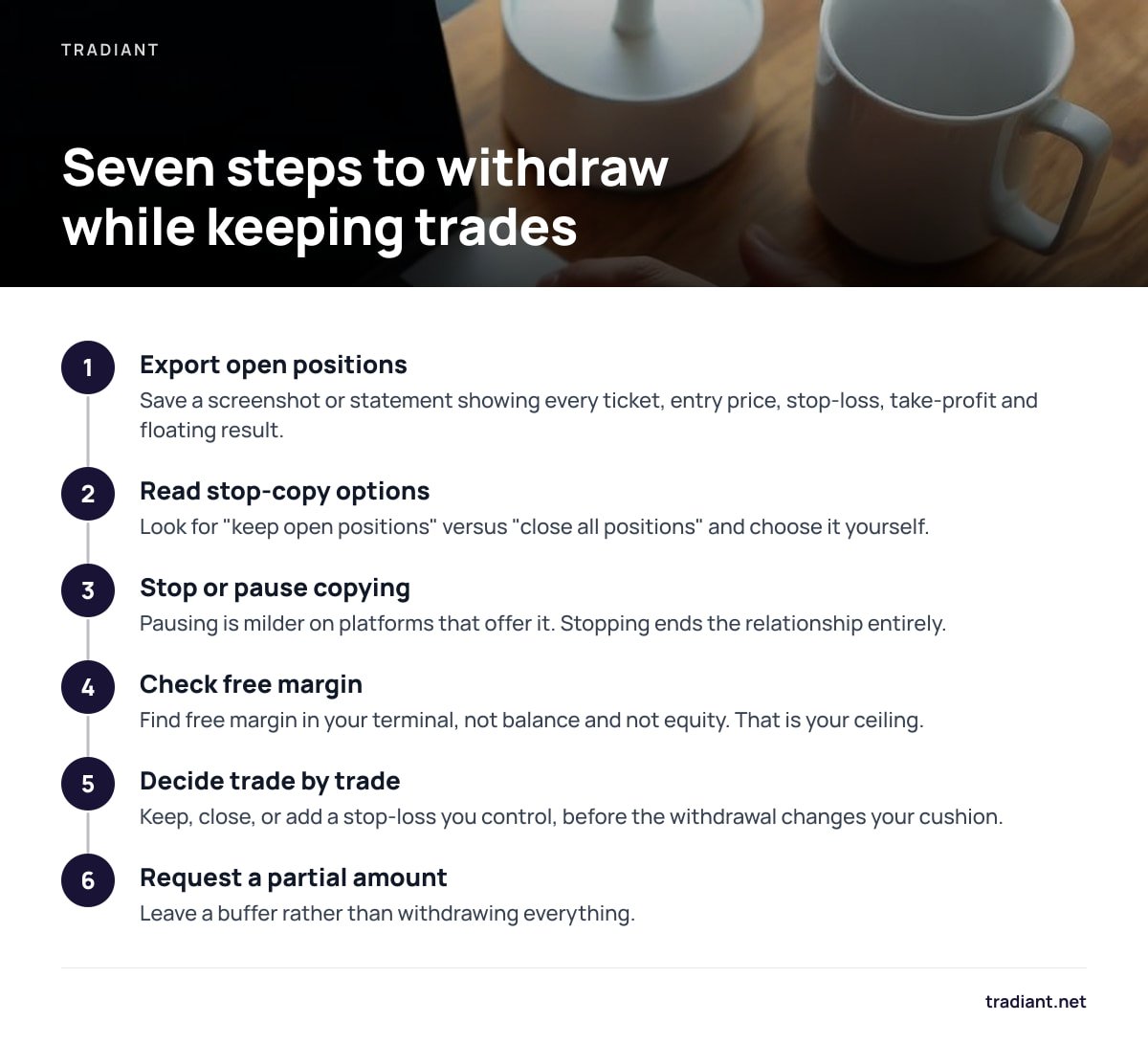
- Export your open positions. Save a screenshot or statement showing every ticket, entry price, stop-loss, take-profit and floating result. Once you disconnect, some dashboards stop showing the link between your trade and the provider's.
- Read the stop-copy options. Look for wording such as "keep open positions" versus "close all positions." The default differs between platforms, and you want to choose it, not discover it.
- Stop copying, or pause new trades. Pausing is the milder option on platforms that offer it. Stopping ends the relationship entirely.
- Check your free margin. Open your trading terminal and find free margin, not balance and not equity. That is your ceiling.
- Decide trade by trade. Keep, close, or add a stop-loss you control. Do this before the withdrawal, because the withdrawal changes your cushion.
- Request a partial amount. Leave a buffer (the next sections show how big).
- Confirm the payout route. Check that your identity verification is complete and that the destination matches how you funded the account.
What Happens to Open Trades When You Stop Copying
The options below appear on most copy platforms in some form. Names vary, so check the exact wording on yours.
| Setting you choose | What happens to open trades | Use it when | Main risk |
|---|---|---|---|
| Stop copying, keep positions | Trades stay open and unlinked from the provider | Every trade has a stop-loss and you can watch them | Nobody exits for you, and swap fees keep accruing |
| Stop copying, close all | Everything closes at market | The provider averages down or runs grids, or you want a clean break | Locks in floating losses and pays the exit spread |
| Pause new copies only | Existing trades usually keep following the provider's exits | You want to add no new risk but keep exits mirrored | Behavior differs by platform, so test with a small account first |
| Withdraw only | Trades and copying continue | You want cash out and still trust the strategy | Free margin shrinks and stop-out risk rises |
My pick is "keep positions" only when every open trade has a stop-loss, and "close all" otherwise. A trade with no stop and no manager is a player left on the field with no coach, and averaging strategies can turn a small floating loss into a large one while you are away. The forex copy trading leaderboard rarely shows how a provider handles floating losses, which is the very thing you inherit when you disconnect.
Free Margin Is the Real Withdrawal Limit
Your balance is not what you can withdraw. Open trades lock up margin, and the broker will only release what is left over. Leverage decides how much gets locked. Under the 30:1 cap that ESMA introduced in 2018 for retail clients trading major currency pairs (Australia's ASIC adopted the same 30:1 limit in 2021), one standard lot of EUR/USD ties up about 3.3% of its value as margin.
One standard lot of EUR/USD at 30:1 leverage locks roughly €3,333 as margin (100,000 divided by 30) before the trade has made or lost a cent.
Here is a worked example for a $2,000 account with open trades:
| Figure | Amount |
|---|---|
| Deposit balance | $2,000 |
| Floating loss | -$300 |
| Equity | $1,700 |
| Margin in use | $600 |
| Free margin | $1,100 |
| Margin level (equity ÷ margin) | 283% |
You could request $1,100, but that would be a mistake. Equity would drop to $600 against $600 of margin, a 100% margin level. In the EU, ESMA's rules require retail CFD providers to start closing positions when equity falls to 50% of required margin, so the next $300 of floating loss would trigger forced closures at the worst moment. Withdrawing about $550 instead leaves equity near $1,150 and a margin level around 192%. Other brokers and jurisdictions set their own stop-out levels, so look up yours.
Pro Tip: Before you disconnect from a provider, add your own stop-loss to every position that has none, and check which positions will cross the Wednesday rollover. Most brokers charge triple swap on Wednesday for spot forex, and a trade that is no longer being managed will keep paying it. A position you meant to ignore can quietly cost you 3 days of swap in a single night.
Fees and Timing: What Can Shrink or Delay Your Payout
Even a clean exit can cost more or take longer than expected. These are the usual causes.
- Profit-share settlement. Providers commonly calculate their performance fee at the end of a weekly or monthly period. Leaving mid-period may trigger an early settlement, so read the fee terms before you request anything.
- Same-route payouts. Brokers generally return money to the method you funded with, in the same name, as part of anti-money-laundering checks. Expect card refunds to be capped at what you deposited by card, with profit going out by bank transfer.
- Incomplete verification. An unverified account is the most common reason a first withdrawal sits in review. Finish identity and address checks before you need the cash.
- Processing windows. Brokers batch withdrawals at set times. A request made late Friday can sit until Monday, and bank transfers add their own days.
- Currency conversion. If your account is in one currency and your bank in another, the conversion rate and fee come out of your payout.
If you are a beginner starting small, these costs matter more than they look. We walked through the arithmetic in what really happens to a $500 copy trading account.
When a Withdrawal Stalls or the Provider Goes Quiet
Delays happen on legitimate platforms. A stall that lasts for weeks, or comes with new demands, is a different thing.
First, put the request in writing through the platform's ticket system and keep copies. Then verify who you are dealing with. In the UK, the FCA Financial Services Register shows whether a firm is authorized. In the US, the National Futures Association's BASIC database lets you look up registered futures and forex firms and their disciplinary history. In Australia, MoneySmart, ASIC's consumer site, has guidance on checking a firm's license before you deposit.
If the provider has vanished instead of the broker, that is a different problem, covered in what happens to your trades when a copy trading provider stops trading. Your trades sit at the broker, so contact the broker directly.
A legitimate firm deducts fees from your balance. It does not ask you to send a "tax," "unlock fee" or "verification deposit" before it releases your own money. That request is the signature of a recovery scam, so stop paying and escalate to your regulator and bank.
Partial Exit or Full Exit: What I Would Pick
I would take a partial exit first, almost every time. Withdraw your original deposit, or the largest amount that keeps your margin level comfortably above 150%, and leave the rest running. It is like bringing your best player off to rest at halftime: you protect the main asset and still see how the second half plays out. If the provider then has a drawdown, you are playing with house money, and the decision to stay or leave gets a lot calmer.
A full exit makes sense when the provider has changed strategy, their drawdown has passed the level you set when you started, or you can no longer watch the account. If your goal is to cap damage instead of leaving, a rule that pauses trading after a set loss is often better than a full exit, and auto-pausing EAs after drawdown shows the settings that work.
Keep Your Funds in Your Own Broker Account and Exit on Your Terms

Tradiant is built so the withdrawal question stays simple. Its Goldenhawk robot trades on your own broker account, so there is no pooled platform wallet between you and your money, and a withdrawal is a request to your own broker. You start from $500, keep 80% of profits, and pay a 20% high-watermark success fee that is zero in losing months, with no setup, monthly or management fees. The service opens in early 2027.
The same free-margin math applies to our robots. Open trades lock margin on your account, so you can only withdraw what is free, and we will tell you to pause trading before a large withdrawal. Your broker's payout speed, limits and verification rules are theirs, so read their terms first. Nothing here guarantees profit. Our 24/7 live chat can walk you through the exit steps, and booked calls are free.
Frequently Asked Questions
Can I withdraw from a copy trading account while trades are still open?
Yes, but only up to your free margin, which is equity minus the margin your open trades use. Anything backing live trades stays locked until they close. Withdraw less than the maximum so a small adverse move doesn't trigger a forced close.
Does stopping copy trading close my open positions?
It depends on the platform and the option you pick. Some platforms offer a choice between keeping positions open and closing them all, and others close them by default. Check the wording before confirming, because closing at market locks in any floating loss.
What happens to my trades if I stop copying and keep them open?
They keep running on your broker account, but the provider no longer manages their exits. They still follow their original stop-loss and take-profit, and they still pay swap fees. If a trade has no stop-loss, add one yourself.
How long does a copy trading withdrawal take?
It varies by broker and payment method. Brokers usually review the request first, then process it in batches, and bank transfers add further days. Completing identity verification before your first request removes the most common delay.
What should I do if my copy trading withdrawal is delayed?
Submit the request in writing through the platform's ticket system and keep copies. Verify the firm on a regulator register such as the FCA Financial Services Register or the NFA's BASIC database. Do not pay any fee to release your own funds, since legitimate firms deduct costs from your balance.
Is it better to withdraw everything or only part of my copy trading account?
A partial withdrawal is safer when you still have open trades. Taking out your original deposit and leaving the rest running protects your capital while keeping your margin level healthy. A full exit makes sense if the provider's strategy or drawdown no longer fits what you signed up for.
Sources
- European Securities and Markets Authority (ESMA) | ESMA
- FCA Financial Services Register | Financial Conduct Authority
- BASIC (Background Affiliation Status Information Center) | National Futures Association
- MoneySmart | Australian Securities and Investments Commission
