
The minimum deposit forex broker floor is $0 to $10 at a small group of cent and micro account providers, and $50 to $200 at most mainstream brokers. That number on the sign-up page is only the cost of getting through the door. Under 30:1 leverage, a $10 account cannot open even one micro lot of EUR/USD, so we would call $250 a practical minimum and $500 a comfortable one.
TL;DR:
- Brokers accept anywhere from $0 to $200 to open a live account, with $50 to $100 the most common mainstream range. The opening minimum and the amount you can trade sensibly are different numbers.
- Under 30:1 leverage, one micro lot of EUR/USD ties up about $36 in margin, so a $10 deposit only works on cent accounts or very high leverage.
- A $1 or R100 (roughly $5 to $6) deposit is possible at a few providers, but payment fees and spreads can eat a large share of it.
- No-deposit bonuses of $200 are rare and almost always come with volume conditions that make withdrawal hard.
- For a deposit you can actually trade with, aim for $250 to $500, and verify the regulator before you fund anything.
Table of Contents
- What a Minimum Deposit Forex Broker Will Actually Accept
- Minimum Deposit Tiers From $1 to $500, and What Each Buys
- Why Margin and Leverage Caps Decide Your Real Minimum
- Can You Start With $10, $1, or R100? Direct Answers
- The $200 No-Deposit Bonus: What Is Behind the Offer
- Hidden Costs That Raise Your Real Minimum
- How to Verify a Low-Minimum Broker Before You Fund It
- What We Would Pick: Match the Deposit to the Job
- Hands-Off Forex From $500, With Nothing Charged in Losing Months
- Frequently Asked Questions
- Sources
What a Minimum Deposit Forex Broker Will Actually Accept
Brokers publish a minimum deposit, but it is a marketing number. It is the smallest amount their payment system will credit to a live account, and it says little about whether you can place a sensible trade.
In practice the market splits into three groups:
- Zero to $10 providers. These are mostly cent-account or micro-account offers. A cent account shows your balance in cents, so $10 appears as 1,000 cents, and the smallest trade size is tiny. They let you test a platform with real money.
- $50 to $200 mainstream brokers. Most regulated brokers sit here for a standard or micro account. The minimum covers the entry fee, not a comfortable trading budget.
- $500 and above. Premium account tiers, managed accounts and anything that requires tighter spreads usually start here.
This article covers one narrow question: what is the lowest deposit you can use to open a live account, and what does it buy? If you are weighing whether to skip manual trading altogether, we cover that separately in our guide to automated forex trading.
Minimum Deposit Tiers From $1 to $500, and What Each Buys

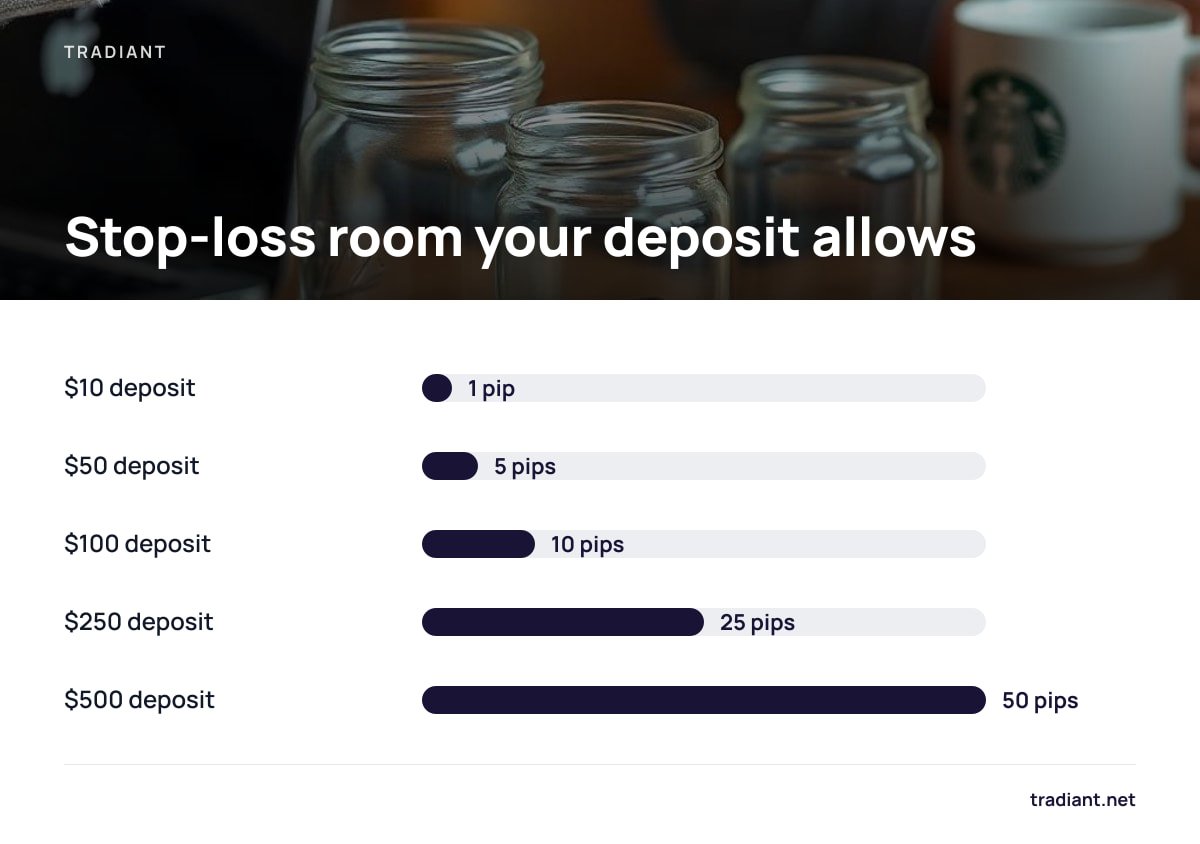
Lot size is the simplest way to see what a deposit can do. A micro lot (0.01 on most platforms) is 1,000 units of currency. On EUR/USD, one pip is worth about $0.10 on that size. If you risk 1% of your balance per trade, the table shows how many pips of stop-loss your deposit allows.
| Deposit | 1% risk per trade | Stop-loss room on 0.01 lot | Realistic use |
|---|---|---|---|
| $10 | $0.10 | 1 pip | Platform test only |
| $50 | $0.50 | 5 pips | Learning order execution |
| $100 | $1.00 | 10 pips | Very tight scalping, little room for error |
| $250 | $2.50 | 25 pips | Short-term trades with defined risk |
| $500 | $5.00 | 50 pips | Swing trades with a normal stop |
EUR/USD often moves 20 to 50 pips over a few hours. A 1-pip stop will be hit by spread and noise alone. That is the trade-off with small deposits: you can sit in the game, but you cannot hold a real position.
Why Margin and Leverage Caps Decide Your Real Minimum
Regulators limit how much leverage a retail trader can use. ESMA's product intervention measures cap leverage at 30:1 on major currency pairs for retail clients in the European Union, and national regulators in the bloc apply them. ASIC applies the same 30:1 limit to retail clients in Australia. In the United States, NFA rules require 2% margin on major pairs, which is 50:1, and 5% on others.
Those caps create a hard floor that no marketing page mentions:
At 30:1 leverage, one micro lot of EUR/USD near 1.08 ties up about $36 in margin. A $10 deposit cannot open it.
At $100, you could technically open two or three micro lots, but a small move against you would trigger a margin call. ESMA's rules also require brokers to close positions when equity falls to 50% of required margin, which on a thin account happens quickly.
Brokers that advertise $1 or $5 minimums with 500:1 or 1000:1 leverage get around this by operating under lighter regulation. The leverage lets a tiny balance open a trade, and it magnifies your losses the same way. The protections regulators require, such as negative balance protection, may not apply.
Can You Start With $10, $1, or R100? Direct Answers
Can you start forex trading with $10?
Yes, but only on a cent or nano-lot account, or with very high leverage from a lightly regulated broker. On a regulated 30:1 account, $10 will not cover the margin for a standard micro lot. If you do it, treat it as a platform test and expect to lose it while learning order entry.
Which broker can I deposit $1?
A small number of cent-account providers accept deposits of $1 to $5. We are not going to name them, and you should be skeptical of any list that does. Check the payment method instead. Card processors, e-wallets and bank transfers often have their own minimum or flat fee, so a $1 deposit can cost 50 cents to move. Check the regulator, the withdrawal terms and the cashier page before you test it.
Can I trade forex with R100?
R100 is roughly $5 to $6 at recent exchange rates, so the answer is the same as for $5: possible on a cent account, impractical elsewhere. If you are in South Africa, check that the broker holds a license from the Financial Sector Conduct Authority and that its FSP number appears on the FSCA register. Also check the rand deposit method. Bank conversion fees on R100 can reach 5% or more of the amount.
The $200 No-Deposit Bonus: What Is Behind the Offer
Searching "$200 no deposit forex bonus South Africa" turns up plenty of promotions, but a $200 offer with no strings is very unlikely. Most no-deposit bonuses are $10 to $50, and the amount is credit, not cash. You usually cannot withdraw it, only profits made from it, and only after meeting a trading volume requirement that can be many times the bonus amount.
Our position: regulated brokers rarely run large no-deposit promotions, and a broker that does is often making up for something else, such as wide spreads, weak oversight or hard withdrawal rules. If a $200 offer appears, read the terms for the lot volume required before withdrawal, the time limit, and whether profits are capped. If any of those is missing from the page, move on.
Hidden Costs That Raise Your Real Minimum
A deposit of $100 is not $100 of trading capital. Several fees come out first.
- Payment fees. Card, e-wallet and wire deposits each carry fees that hit small deposits hardest. A flat $5 wire fee is 5% of a $100 deposit.
- Spread on small accounts. Cent and micro accounts often have wider spreads than standard ones. A 2-pip spread on EUR/USD costs $0.20 on a micro lot, which is 0.2% of a $100 account per trade.
- Withdrawal fees. Some brokers charge a flat fee or set a minimum withdrawal. If the minimum is $50 and you have $40, your money is stuck.
- Inactivity fees. Accounts left idle may be charged monthly after 90 days or so.
- Currency conversion. Depositing in rand, euros or yen into a dollar account adds a conversion margin both ways.
Pro Tip: Before you deposit, make a $20 test withdrawal request on paper by reading the withdrawal page, then check the fee, the minimum and the time. If the cashier does not list them, ask live chat and screenshot the answer. How specific the broker is about getting money out is the best early signal you will get.
How to Verify a Low-Minimum Broker Before You Fund It
A low minimum is only worth it if you can get the money back. Five checks take about ten minutes.
- Find the regulator on the regulator's own site. Do not trust the logo in the footer. Search the license number on the register of the FCA, ASIC, CySEC, FSCA or NFA, depending on the jurisdiction.
- Confirm the entity. The company named in the terms must match the entity on the register, not a sister company offshore.
- Read the leverage and protection terms. Negative balance protection should be written down.
- Check segregation of client funds. The terms should say your money is held separately from the broker's own.
- Test a small withdrawal early. Do it before you add more.
If a broker fails check one or two, the size of the minimum deposit does not matter.
What We Would Pick: Match the Deposit to the Job
If you want to learn the platform, a $10 to $50 cent account is a reasonable training pitch. If you want to trade a real strategy with a stop-loss that noise will not hit, we would start at $250 on a regulated broker. If you want to run an automated approach, $500 gives enough margin for a robot to take its normal trades and survive a rough stretch. Our breakdown of whether $500 is enough to start a forex robot goes through the maths, and managed forex account minimums covers how those arrangements are set up.
Whatever you start with, decide in advance how much you can lose without changing your life. Most retail accounts lose money. Regulators in the EU require brokers to publish the share of clients who lose, and it is usually well above half. Start with money you can afford to see go to zero.
Hands-Off Forex From $500, With Nothing Charged in Losing Months
If your goal is exposure to forex without watching charts, the deposit question changes. Tradiant is building a managed service that runs a rotating squad of trading robots, currently Goldenhawk, a trend-following robot, on your own broker account. Your money stays with your broker, and Tradiant does not take custody. You start from $500, keep 80% of profits and pay a 20% high-watermark success fee, so nothing is charged in a losing month. There are no setup, monthly or management fees.
The service opens in early 2027, so it is not live yet. Your broker must also accept the $500 and meet its own requirements, and a robot can still lose money, including in a long run of choppy markets. Check the live team sheet and the fee terms on the site before you commit, and book a free call if you want a person to walk you through it.
Frequently Asked Questions
What is the lowest deposit to open a live forex account?
A small group of cent-account providers accept $1 to $10, while most mainstream regulated brokers ask for $50 to $200. The opening minimum is only the entry fee. Margin rules under 30:1 leverage mean you need considerably more to hold even a single micro lot of a major pair.
Is a $100 minimum deposit enough to trade forex?
It is enough to open a live account and place micro-lot trades, but you will have little room for stop-losses. At 1% risk on 0.01 lots, $100 gives you about 10 pips of stop room, which ordinary market movement can hit easily. Treat it as a learning account.
Are low minimum deposit brokers safe?
Safety depends on the regulator, not the minimum. A broker licensed by an authority such as the FCA, ASIC, CySEC or FSCA and verified on that regulator's own register is a different proposition from an offshore entity offering 1000:1 leverage. Check the license number and the legal entity before depositing.
Can I get a $200 no deposit forex bonus?
Offers exist, but a $200 bonus without conditions is very unlikely. No-deposit bonuses are usually $10 to $50, locked as trading credit, and require a large trading volume before you can withdraw profits. Read the volume requirement, time limit and profit cap before you accept.
Does a higher deposit lower my trading costs?
Sometimes. Premium account tiers that start at $500 or more can offer tighter spreads and lower commissions, and flat payment fees take a smaller share of a larger deposit. The difference is real but modest, so compare the all-in cost per trade rather than the account label.
Sources
- European Securities and Markets Authority (ESMA) | ESMA
- Australian Securities and Investments Commission (ASIC) | ASIC
- National Futures Association (NFA) | NFA
- Financial Sector Conduct Authority (FSCA) | FSCA South Africa
