
Forex robot results with a $500 account are small in dollars and large in swings. A robot earning 3% a month makes about $15, while a 30% drawdown costs $150. Judge any robot by a verified live track record of at least 12 months and its worst drawdown, because a backtest cannot show the spread, slippage and lot-size limits a small account runs into.
TL;DR:
- A realistic robot on $500 earns roughly $10 to $25 a month in a good stretch, and some months it loses money.
- Drawdown tells you more than monthly gain: a 30% dip is $150 and needs a 43% gain to repair.
- Fixed costs hurt a small account most. A $20 monthly VPS bill is bigger than a 3% monthly gain on $500.
- Trust live results on a real broker account over 12 months or more. Treat backtests and screenshots as a brochure.
- Pay for performance, not upfront. A success fee charged only on new profit keeps your downside limited to trading losses.
Table of Contents
- Forex Robot Results With a $500 Account: What Is Realistic
- Why $500 Behaves Differently: Lot Sizes, Spreads and Leverage Caps
- Drawdown Comes First: The Number That Decides Whether You Stay In
- Backtests, Demo Accounts and Live Results: Which Evidence to Trust
- Red Flags That Should End the Conversation
- The Fee Math: How Costs Eat a $500 Account
- A Sensible Plan for Your First $500
- Start With $500 and Pay Only When You Reach a New High
- Frequently Asked Questions
- Sources
Forex Robot Results With a $500 Account: What Is Realistic
The arithmetic settles most arguments before they begin. The table below shows what different monthly returns mean on $500, with a 20% success fee taken out of each profitable month, which is the structure we use at Tradiant.
| Monthly return | Gross profit | After a 20% success fee | Compounded over 12 months (before fees) |
|---|---|---|---|
| 2% | $10 | $8 | about 27% |
| 3% | $15 | $12 | about 43% |
| 5% | $25 | $20 | about 80% |
| 10% | $50 | $40 | about 214% |
A steady 2% to 5% a month is a strong season. Anything promising 10% a month, every month, assumes a championship run with no injuries. Real accounts have losing months, flat months and a couple of ugly ones, and the average hides all of that.
You should also expect your first year to look lumpy. A trend-following robot, which is the style behind Goldenhawk, tends to take many small losses while it waits for a big move. Judging it after six weeks is like judging a striker after two games.
Why $500 Behaves Differently: Lot Sizes, Spreads and Leverage Caps
A small account has less room for error, and the mechanics explain why. Most brokers let you trade a micro lot (0.01), which is 1,000 units of currency. On EUR/USD that is roughly $0.10 per pip. A 20-pip stop on one micro lot loses about $2, or 0.4% of $500. That sounds fine until a robot opens several positions at once.
Leverage limits also cap what you can do. ESMA restricts retail leverage on major currency pairs to 30:1 across the EU, and ASIC applies the same 30:1 cap on major pairs in Australia. In the United States, NFA rules set 50:1 on major pairs and 20:1 on others. At 30:1, $500 controls about $15,000 of currency, so a robot cannot lean on size to make a small account look big. Offshore brokers that offer 500:1 are selling you a faster way to lose $500.
Spreads matter more than people expect. If a robot trades often and each trade pays 1 pip in spread and commission, a 5-pip average target loses a fifth of its edge before the market does anything. Ask what the robot's average win per trade is in pips, then compare it to your broker's real spread at the hours it trades.
At 3% a month, a $500 account earns $15. A $20 monthly VPS bill is already bigger than that.
Drawdown Comes First: The Number That Decides Whether You Stay In
Drawdown is the drop from a peak balance to the next low. It is the stat that tells you whether you will still be in the game when the robot recovers. A 30% drawdown on $500 is $150, and you then need a 43% gain on the remaining $350 to get back to even. A 50% drawdown needs a 100% gain. We walk through that math in Drawdown Explained.
Look for three figures on any track record:
- Maximum drawdown. The deepest peak-to-trough fall. Under 20% is comfortable for most beginners. Over 40% is a strategy that will test your nerve and your margin.
- Worst single month. If the robot lost 15% once, assume it can happen again while you are watching.
- Recovery time. How many months it took to reclaim the old peak. Two months and fourteen months are very different experiences.
Pro Tip: Take the robot's reported maximum drawdown and multiply it by 1.5 as your planning number. Live drawdowns usually exceed the worst one in a short history, because the history has not yet met every market. If 1.5 times the number makes you want to switch it off, the robot is too aggressive for you, however good the average looks.
Backtests, Demo Accounts and Live Results: Which Evidence to Trust
Evidence is not equal, and the ranking is clear enough to pick from.
| Evidence type | What it shows | What it hides |
|---|---|---|
| Backtest | How rules would have traded old price data | Slippage, requotes, widened spreads, curve-fitting to the past |
| Demo account | Rules running on live prices with fake fills | Real execution and the pressure of real money |
| Live account, short history | Real fills over a few months | Whether the robot has met a hostile market yet |
| Live account, 12+ months, broker-verified | Real fills across several market conditions | Little, if the statement comes straight from the broker |
My pick is the last row, and I would not put money behind anything lower unless the stake was small enough to treat as tuition. Ask for a broker-verified statement, not a screenshot. Screenshots can be cropped, and a profit graph with the drawdown line removed is a marketing asset, not a result.
On the US side, the CFTC has repeatedly warned retail customers about forex fraud and about sellers who promise guaranteed or unusually high returns from automated systems. That warning is worth keeping in mind whenever a robot's results arrive with a countdown timer.
Red Flags That Should End the Conversation
A few patterns show up again and again in robots that eventually wipe small accounts.
- A smooth line that never dips. Real trading has jagged edges. A near-perfect curve often means the robot holds losing positions open or doubles down on them. That is the martingale pattern, and we explain why it ends badly in Martingale Forex EA.
- No stop-loss on open trades. Check the statement. If floating losses grow to 30% before anything closes, the realized results look better than the account really is.
- Returns quoted without the period. "Up 400%" means little without the timeframe and the starting balance. A 400% gain on $50 over a lucky weekend is $200.
- Upfront price larger than your gain. Paying $300 for a robot on a $500 account means you need a 60% gain to break even before the first trade settles.
- Pressure to deposit more. Real strategies do not need your emergency fund to work.
Regulators publish the base rate. When ESMA introduced its restrictions on CFDs, it cited analysis showing that between 74% and 89% of retail CFD accounts lose money. A robot changes that base rate only if the strategy has a real edge and you can survive the bad runs.
Between 74% and 89% of retail CFD accounts lose money, according to the analysis ESMA used to justify its leverage limits.
The Fee Math: How Costs Eat a $500 Account

On a larger account, a monthly software fee is background noise. On $500 it decides the outcome. Take three common structures and apply them to a good 3% month ($15 gross profit):
- Monthly subscription of $30. You are $15 in the red in a good month and $30 in the red in a flat one.
- One-time robot purchase of $300, plus a $20 VPS. You start 60% down and pay rent while you try to dig out.
- Success fee of 20% with a high-watermark. You keep $12 of the $15 and pay nothing in a losing month. After a loss, the fee returns only once the account passes its previous peak.
I would take the third structure every time on a small account. It aligns the money: the person running the strategy only gets paid when you reach a new high. If you want the full comparison of custody, fees and withdrawal terms across setups, Forex Managed Account covers it.
Keep the money in your own broker account. If anyone asks you to send funds to a pooled account or a private wallet, walk away. Withdrawing should always be a request to your own broker, not to a third party.
A Sensible Plan for Your First $500
I would play it this way, in order.
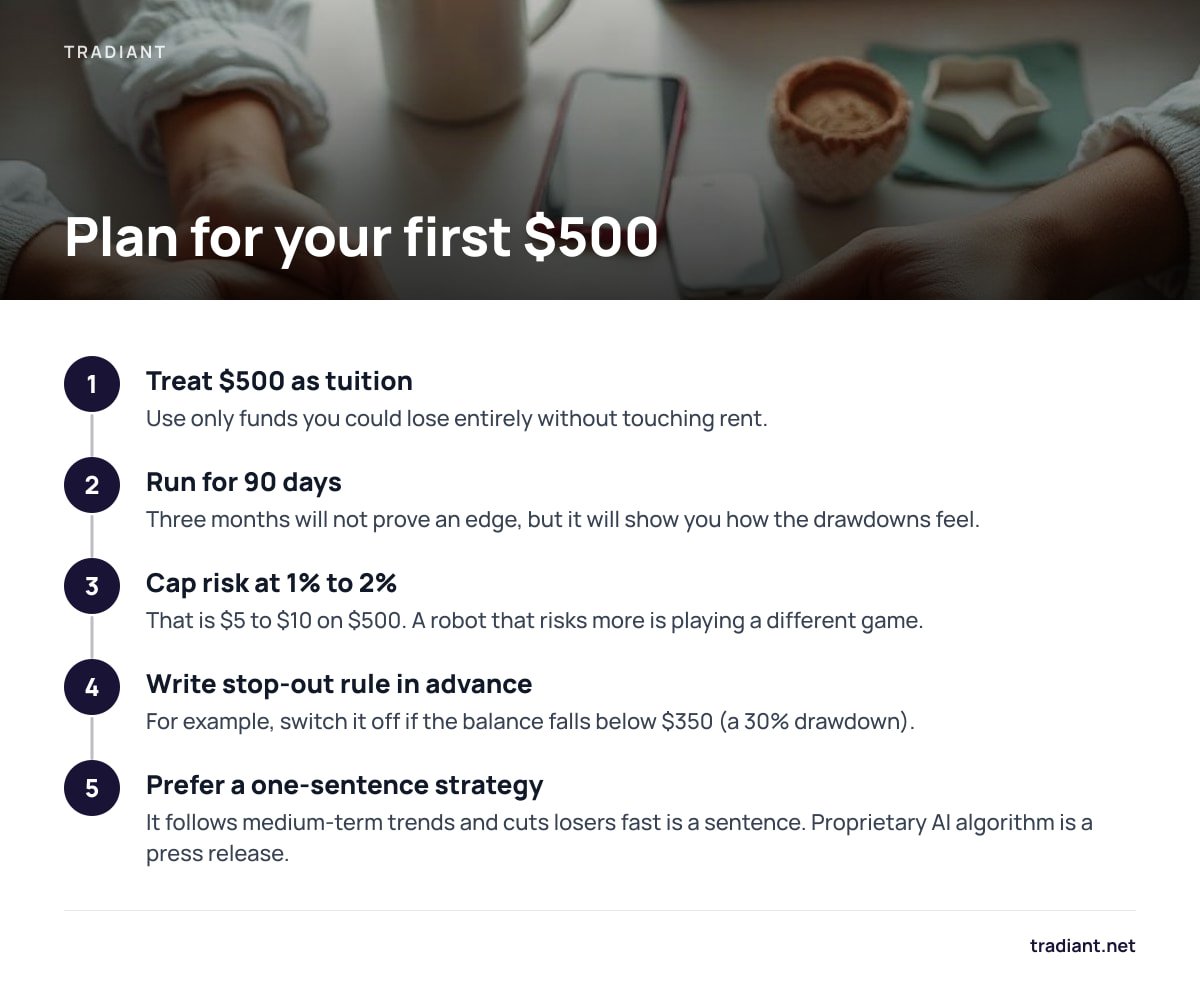
- Treat $500 as tuition money. Use only funds you could lose entirely without touching rent.
- Run for 90 days before judging. Three months will not prove an edge, but it will show you how the drawdowns feel.
- Cap risk at 1% to 2% of the account per trade. That is $5 to $10 on $500. A robot that risks more than that per position is playing a different game from your budget.
- Write your stop-out rule down in advance. For example, switch it off if the balance falls below $350 (a 30% drawdown). Deciding in the moment is how people turn a $150 loss into a $400 one.
- Prefer a strategy you can describe in one sentence. "It follows medium-term trends and cuts losers fast" is a sentence. "Proprietary AI algorithm" is a press release.
Copy trading is the other route beginners consider. It has its own traps, mainly leaderboards that reward recent luck, and we cover them in Forex Copy Trading.
Start With $500 and Pay Only When You Reach a New High
Tradiant is built around the problems above. It runs a rotating squad of trading robots, currently Goldenhawk, on your own broker account, so your money stays where it is. You start from $500, keep 80% of profits and pay a 20% high-watermark success fee. There are no monthly, setup or management fees, and nothing is charged in a losing month. A live team sheet shows which robots are active and which are benched, and human live chat is available around the clock if you want to ask about a drawdown before you fund anything.
The honest limit: Tradiant opens in early 2027, and no robot, ours included, can promise a return. A $500 account will have losing months, and a trend-following style can sit through a long flat patch before a big move arrives. Read the live record once it exists, check your broker's minimum lot size and spreads, and decide your stop-out level before you deposit.
Frequently Asked Questions
How much can a forex robot realistically make on a $500 account?
In a good stretch, 2% to 5% a month is a reasonable range, which is $10 to $25 before fees. Many months will be flat or negative, and the first year is rarely smooth.
Is $500 enough to run a forex robot safely?
It is enough to run one at micro-lot size with risk of 1% to 2% per trade, which is $5 to $10. It is thin for any strategy that needs several open positions at once, so check the robot's typical position count before you fund the account.
Why do backtest results look better than live results?
A backtest uses historical prices with ideal fills, so it leaves out slippage, wider spreads during news and execution delays. It can also be tuned to past data until the curve looks perfect, which says little about the next six months.
What drawdown is acceptable for a beginner?
Under 20% is a comfortable ceiling for most new traders. A 30% drawdown on $500 is $150 and needs a 43% gain to recover, so decide your stop-out level before you start.
Do I have to hand over my money to use a managed robot service?
No. A well-built service trades on your own broker account, so funds stay in your name and you can withdraw through the broker. Be cautious of anyone who asks you to send money to a pooled account or personal wallet.
Sources
- Product intervention measures on CFDs and binary options | ESMA (European Securities and Markets Authority)
- Consumer protection and forex fraud advisories | CFTC (U.S. Commodity Futures Trading Commission)
- Forex investor information and leverage rules | NFA (National Futures Association)
- CFD product intervention order and retail leverage limits | ASIC (Australian Securities and Investments Commission)

Pingback: Managed Forex Account Minimum $500: How It Works and Risks - Tradiant
Pingback: Is $500 Enough to Start a Forex Robot in 2024? - Tradiant