
The best account type for beginners is a regulated broker's standard account that allows 0.01-lot (micro) positions, opened after a few weeks on demo. The label on the account matters less than two things: who regulates the broker, and whether the smallest trade size lets you risk 1% to 2% of your balance per trade. On $500, that is $5 to $10.
TL;DR:
- Pick a standard account at a regulated broker that allows 0.01-lot trades. It is the simplest setup for a $500 start.
- Cent accounts feel safe but show your balance in cents, which can distort how you judge risk. Raw-spread accounts save active traders money, but at 0.01 lots the savings are pennies.
- Risk $5 to $10 per trade on $500. Set the stop distance first, then work out the lot size.
- Making $200 a day on $500 means a 40% daily return. The research on day traders says almost nobody sustains anything close.
- Park emergency cash in an insured high-yield savings account and put long-term money in a broad index fund before you fund a forex account.
Table of Contents
- The Best Account Type for Beginners Comes Down to Two Numbers
- Account Types Compared: What Each One Means for a $500 Beginner
- Which Trading Account Is Best for Beginners: Cent, Standard or Raw Spread?
- Leverage Limits by Region, and Why You Should Use Far Less
- Can You Make $200 a Day Day Trading? The Math on a $500 Account
- Best Savings Account and Best First Investment: What Comes Before Forex
- Managed Accounts and Robots: What to Check Before You Choose One
- Start From $500 Without Handing Over Your Money
- Frequently Asked Questions
- Sources
The Best Account Type for Beginners Comes Down to Two Numbers
Brokers sell accounts called Standard, Cent, Raw, Pro, Prime and a dozen other names, and the same name means different things at different firms. Two numbers mean the same everywhere. The first is the smallest trade size the account allows. The second is how much of your balance you lose when a stop is hit.
On a $500 balance, risking 1% is $5 and risking 2% is $10. An account that cannot trade 0.01 lots (a micro lot, or 1,000 units of currency) cannot hit that target on most pairs, whatever it is called.
At 0.01 lot on EUR/USD, one pip is worth about $0.10, so a 50-pip stop risks $5. That is exactly 1% of a $500 account.
If you would rather not size trades yourself, a managed robot running on your own broker account is a different route. Automated Forex Trading: How It Works and What $500 Gets You covers it in full. The rest of this guide is about choosing the account you fund in the first place.
Account Types Compared: What Each One Means for a $500 Beginner
Here is how the common types stack up for someone funding a first account with $500. "Fits $500" is my judgment, not a broker rule.
| Account type | Who it suits | Main catch | Fits $500? |
|---|---|---|---|
| Demo | Everyone, for the first few weeks | Fake money hides fear, and fills can be cleaner than live | Free, so use it first |
| Cent | Learners funding well under $100 | Balance is shown in cents, which distorts how real the risk feels | Works, but I would skip it |
| Standard (micro-lot capable) | Most beginners | The spread is your cost, so check it on the pairs you trade | Yes, my pick |
| Raw spread / ECN | Frequent traders | A commission per lot on top of a tight spread | Yes, if you trade often |
| Managed on your own broker account | People who want hands-off exposure | Results are never guaranteed, and fees differ by provider | Yes, if custody stays with you |
| Pooled managed fund | Investors comfortable with manager custody | Your money sits in a shared pool you do not control | Check the regulator first |
Minimum deposits vary a lot by broker, and what you can really start with is often higher than the headline figure once lot size and margin are counted.
Which Trading Account Is Best for Beginners: Cent, Standard or Raw Spread?
My pick is the standard account with micro-lot trading. Here is the reasoning for each option.
Cent accounts
A cent account counts your balance in cents, so $500 appears as 50,000 units. The idea is that small positions feel less scary. In practice it can make losses look like game points, and that habit is hard to unlearn when you move to a normal account. Cent accounts are fine as a short experiment with a very small deposit. They are a poor home for a first serious $500.
Standard accounts
A standard account has no commission. You pay through the spread, so your cost per trade is one number you can see on the screen. If the broker allows 0.01-lot trades, you can size positions to a 1% risk rule without any workaround. For someone placing a few trades a week, this is the least confusing setup.
Raw-spread accounts
Raw-spread accounts quote a spread close to the interbank price and charge a commission instead. Many brokers charge around $6 to $7 per round-turn standard lot, so roughly $0.07 on a 0.01-lot trade, but check the actual schedule. If the standard account's spread is about a pip wider, that is $0.10 per trade at the same size.
Raw is cheaper for active traders, though at beginner size the gap is a few cents per trade. Position size and stop distance decide whether your $500 survives, and the pricing model matters far less.
Leverage Limits by Region, and Why You Should Use Far Less
Regulators cap leverage for retail clients because it is the fastest way for a beginner to lose a small account. The measures ESMA coordinated in 2018 limit retail leverage to 30:1 on major currency pairs, add negative balance protection and require a standard risk warning showing the share of retail accounts that lose money. National regulators in Europe now enforce equivalent rules. In the US, the National Futures Association sets retail forex leverage at 50:1 on major pairs and 20:1 on others. In Australia, ASIC capped retail leverage at 30:1 on major pairs in 2021.
Some brokers outside these regimes advertise several hundred to one. A beginner gains nothing from it. Take EUR/USD near 1.10: a 0.01-lot position is about $1,100 of exposure. At 30:1 the broker holds roughly $37 as margin, and on a $500 balance your real leverage is about 2.2:1. That is a sensible number. If your effective leverage climbs past 10:1 on a small account, the account type is not the problem. Your position size is.
Pro Tip: Reset your demo balance to $500 before you start, and run the demo on the same broker and account type you plan to fund. Default demo balances of $10,000 or $100,000 hide how little room a $500 account has. A 50-pip losing streak that is a shrug on a big demo is a 20% drawdown on the real thing, and you want to feel that in practice first.
Can You Make $200 a Day Day Trading? The Math on a $500 Account
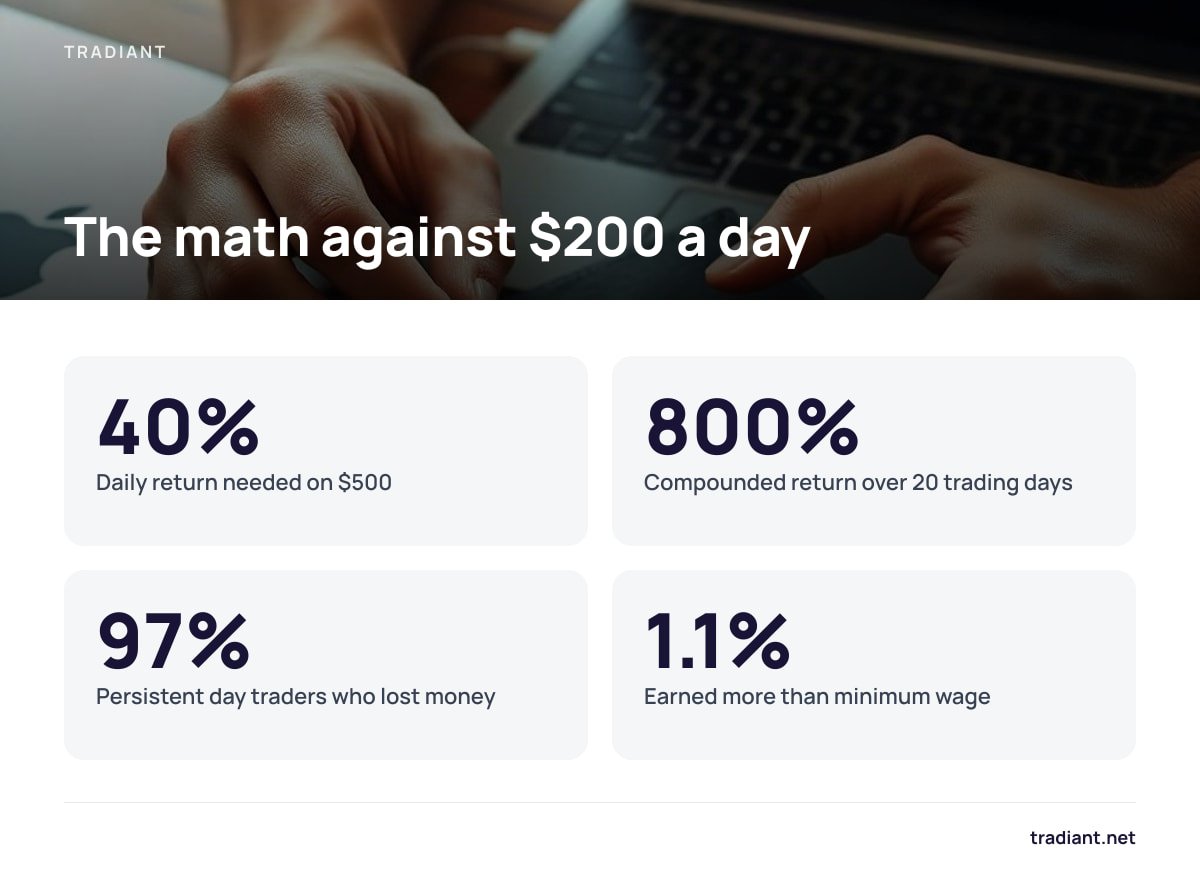
On a $500 account, $200 a day is a 40% return in 24 hours. Repeated across 20 trading days it is $4,000, or 800% in a month. Nobody sustains that, and the people who advertise it are usually selling something.
The best-known research points the same way. A study of Brazilian futures day traders by economists Fernando Chague, Rodrigo De-Losso and Bruno Giovannetti followed people who kept at it for at least 300 days. It found that 97% lost money and only 1.1% earned more than the minimum wage. The risk warnings that European brokers must publish also commonly show a majority of retail accounts losing money, often 70% or more.
Some people do have $200 days, mostly on larger accounts and with a good deal of luck. As a plan for a $500 start, the answer is no. Aim to survive your first three months with your risk rules intact. Most beginners don't manage that.
Best Savings Account and Best First Investment: What Comes Before Forex
Two questions people ask alongside this one are about savings and investing, and both come before forex.
Best type of savings account. For money you may need within a year, a high-yield savings account at an insured bank is the standard choice. You can withdraw anytime, and the rate usually beats a regular checking account. In the US, FDIC insurance covers up to $250,000 per depositor, per insured bank, per ownership category. In the EU, the deposit guarantee floor is €100,000 per depositor per bank. Outside those regions, look up your country's deposit guarantee scheme before you pick a bank.
Best investment for beginners. I would pick a broad, low-cost index fund held for years. It gives you a share of hundreds or thousands of companies for a small annual fee, with no stock-picking skill required. Forex is speculation. A currency pair has no dividends or earnings behind it, so what one trader gains, another loses, minus the spread.
The order I would follow is an emergency buffer in savings, then a regular index fund contribution, then a forex account funded only with money you can afford to lose entirely.
Managed Accounts and Robots: What to Check Before You Choose One
A managed setup on your own broker account is a legitimate choice for beginners who want market exposure without placing the trades. It is also where most of the fine print lives. Before funding one, check these points:
- Custody. Your money should stay in an account under your own name at a regulated broker. The manager or software should have trading permission only, with no right to withdraw.
- Fee structure. Ask what you pay in a losing month. A success fee with a high-watermark charges only on new profit above your previous peak. A flat monthly fee charges you regardless.
- Automation permission. Confirm the broker allows automated trading on the account type you plan to open, and ask the provider which account types it supports.
- Live record. Ask for results from real accounts rather than backtests, and ask how the provider reports losing periods.
- Exit terms. You should be able to revoke access and withdraw at any time.
For the detailed version, see Managed Forex Account Minimum $500: How It Works and Risks. If you are weighing whether the amount is enough, Is $500 Enough to Start a Forex Robot runs the numbers.
Start From $500 Without Handing Over Your Money

If you would rather not pick lot sizes and stop distances yourself in week one, Tradiant is building a managed service that runs a rotating squad of trading robots on your own broker account. It currently has one, Goldenhawk, a trend-following forex robot. Your money stays with your broker, in your name. You start from $500 and keep 80% of profits. The 20% high-watermark success fee means nothing is charged in a losing month, and there are no setup, monthly or management fees. A live team sheet shows which robots are playing and which are benched.
The service opens in early 2027, so you cannot fund it today, and a robot can still lose money, including through long drawdowns. Check which broker account type it supports before you open one, and ask Tradiant on live chat or a free booked call if anything in the spec sheet is unclear.
Frequently Asked Questions
Which is the best trading account for beginners?
A standard account at a regulated broker that allows 0.01-lot trades is the simplest choice for most beginners. It has no commission, one visible cost (the spread) and a trade size small enough to risk 1% to 2% of a $500 balance. Open a demo on the same broker first.
Is a cent account good for beginners?
A cent account can work for a short experiment with a very small deposit. It shows your balance in cents, so $500 looks like 50,000, which can make real losses feel like game points. For a first serious account, a standard account with micro-lot trading builds better habits.
Can you make $200 per day in day trading?
Some traders have $200 days, but sustaining it on a $500 account would mean a 40% daily return. A study of Brazilian futures day traders who persisted for at least 300 days found 97% lost money and only 1.1% earned more than the minimum wage. Treat $200 a day as a marketing line, not a plan.
What is the best type of savings account to save money?
A high-yield savings account at an insured bank or credit union suits most people, because you can withdraw anytime and the rate usually beats a checking account. In the US, FDIC insurance covers up to $250,000 per depositor, per bank, per ownership category. Use certificates of deposit only for money you will not touch until they mature.
What investment is best for beginners?
A broad, low-cost index fund held for years is the usual pick, since it spreads your money across many companies for a small fee. Forex trading is speculation, not investing, so fund it only after your savings buffer and long-term investing are in place, and only with money you can afford to lose.
Sources
- ESMA, Press Releases and Product Intervention Measures on Retail Leveraged Products | European Securities and Markets Authority
- Forex Investor Information and Leverage Rules | National Futures Association
- Product Intervention Order for Retail Leveraged Products | Australian Securities and Investments Commission
- Deposit Insurance Coverage | Federal Deposit Insurance Corporation
- Day Trading for a Living? (Chague, De-Losso, Giovannetti) | SSRN
