
Taxes on forex robot trading profits work the same way as taxes on trades you click yourself: tax authorities do not care who or what pressed the button. Your bill depends on how your country classifies forex gains (ordinary income, capital gain, or tax-free spread bet) and whether you can document every closed trade. A robot can create thousands of taxable events a year, so record-keeping is the hard part.
TL;DR:
- Forex robot profits are taxable in most countries. The robot is irrelevant; the account type and your residency decide the rules.
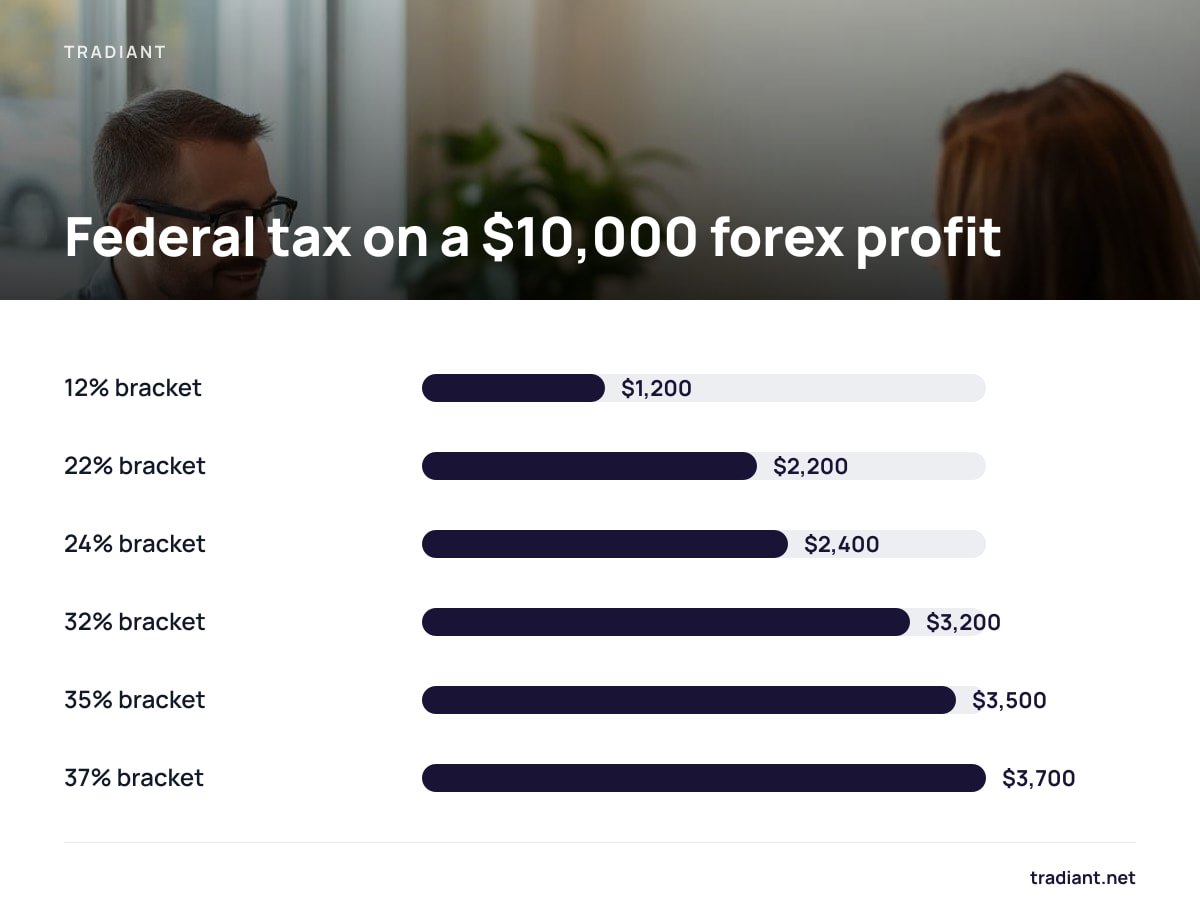
- In the US, spot forex defaults to ordinary-income treatment under Section 988, so a $10,000 profit is taxed at your marginal rate, roughly $1,200 to $3,700 federal.
- Every closed trade is a taxable event, so a robot that trades daily produces thousands of line items you need records for.
- Fees, swaps, commissions and VPS costs may reduce your taxable profit, but deductibility varies sharply by country.
- Earning $100 a day is plausible on a large account and absurd on a $500 one, and your tax position follows your actual results, not your target.
Table of Contents
- Do You Have to Pay Tax on Forex Robot Profits? Usually Yes, With Three Exceptions
- How the Main Tax Systems Treat Forex Profits
- What a $10,000 Forex Profit Costs in Tax
- Why a Robot Makes Record-Keeping Harder, and What to Save
- Which Robot Costs You Can Deduct, and Which You Probably Cannot
- Can You Make $100 a Day on Forex, and What Does That Do to Your Taxes?
- Is Forex Trading Like Gambling? What Tax Rules Say About It
- Reporting, Cross-Border Visibility and Mistakes That Cost Money
- Get Tax-Ready Forex Robot Records on Your Own Broker Account
- Frequently Asked Questions
- Sources
Do You Have to Pay Tax on Forex Robot Profits? Usually Yes, With Three Exceptions
In most countries you owe tax on forex profits, and a robot makes no difference. Your broker records each closed trade, and your tax authority sees a gain or a loss. Whether it came from a person, a script or an expert advisor is not a field on any tax form. If you are still deciding whether to fund a robot at all, the beginner's checklist on forex robots covers that question. This article assumes you are already trading or about to.
The exceptions are narrow:
- Tax-free jurisdictions. The UAE, for example, generally has no personal income tax on individuals' investment income, so private forex profit is typically untaxed there. Residency rules still matter, and changing the country on your account does not move your tax home.
- Spread betting in the UK. Profits from spread bets are generally free of both capital gains tax and income tax for most individuals, because they are treated as betting. Spot forex and CFDs are taxable.
- Losses. If you finish the year down, you owe nothing on trading, though how much of the loss you can use varies by country.
If you are a UK resident, the GOV.UK capital gains tax guidance is the place to confirm your own position. An annual exempt amount applies before CGT starts, and it changes, so check the current figure instead of trusting a blog post, including this one.
How the Main Tax Systems Treat Forex Profits
The label your country puts on forex gains matters more than the amount. Here is how the common systems line up for a retail trader using a standard spot or CFD account.
| Jurisdiction | Typical treatment | What to check |
|---|---|---|
| United States | Ordinary income by default under Section 988 | Whether a timely capital-gain election is available and worth it |
| United Kingdom | Capital gains tax for spot FX and CFDs; spread bets generally exempt | Annual exempt amount; whether frequent trading counts as a trade |
| Australia | Assessable income or capital gain, depending on whether you run a trading business or invest personally | Records, and the ATO's view of your trading pattern |
| Singapore, Hong Kong | No general capital gains tax | Frequent, systematic trading can be treated as business income |
| Germany and much of the EU | Investment income or capital income rules, varying by country | Loss-offset limits for derivatives and CFD-style products |
In the US, Section 988 of the Internal Revenue Code treats gains and losses on foreign currency transactions as ordinary income or loss. The Australian Taxation Office separates people carrying on a business of trading from people investing, and that line changes how profits are assessed. A robot that fires dozens of trades a week pushes you toward the "business" end of both tests, whatever you call yourself.
I would not guess at your category. Pay a local accountant once, early, to confirm it. The fee is small next to the cost of three years of wrongly filed returns.
What a $10,000 Forex Profit Costs in Tax
Take a US trader who nets $10,000 from a robot in a year, with nothing else changing. Under default Section 988 treatment, that profit lands on top of your other income at your marginal rate.
| Federal bracket | Tax on $10,000 profit | You keep |
|---|---|---|
| 12% | $1,200 | $8,800 |
| 22% | $2,200 | $7,800 |
| 24% | $2,400 | $7,600 |
| 32% | $3,200 | $6,800 |
| 35% | $3,500 | $6,500 |
| 37% | $3,700 | $6,300 |
These are federal rates only, and they assume you can't net the gain against losses elsewhere. State tax comes on top in most states.
Many people think electing capital treatment gets you the 15% long-term rate. For robot trading, that rarely helps. Long-term rates need a holding period over one year, and a trend-following robot holds positions for hours or days. Short-term capital gains are taxed at the same ordinary rates, so the election changes less than people think.
Under default Section 988 rules, forex losses are ordinary losses you can deduct against other income, while capital losses are capped at $3,000 a year against ordinary income.
That is the trade-off. Ordinary treatment is no better in a winning year, but it is far better in a losing one. A robot with a rough year can hand you a large deductible loss, and if you elected capital treatment you could be stuck carrying it forward. Ask your accountant which way you lean before the year starts, because the election must be made in advance.
Why a Robot Makes Record-Keeping Harder, and What to Save
A person might place 40 trades a year. A robot can place 40 in a week. Each closed trade is a separate taxable event, and tax software does not enjoy 2,000 rows.
A robot that closes eight trades a day produces roughly 2,000 taxable events in a 250-day trading year.
What you want to have on file at year end:
- Broker statement. The full-year account statement in PDF and, if available, CSV. This is your primary record, and it comes from the broker, not from the robot.
- Trade history export. The MetaTrader detailed report showing open time, close time, lot size, profit, commission and swap per trade.
- Deposits and withdrawals. Dates and amounts, so you never mix up your own capital with profit.
- Currency conversions. If your account is in USD and you file in another currency, you generally need the exchange rate on the relevant date for each conversion, or a method your tax authority accepts.
- Costs. Invoices for VPS hosting, data, software licenses and any performance fees.
Pro Tip: Export your full trade history on the last trading day of every month, not once a year. Brokers cap how far back platform history reaches, and a robot that reconnects can leave odd gaps. A monthly export gives you twelve small files to reconcile against the statement, and you will spot a missing trade while it is still easy to explain.
Your broker choice affects this. Our broker compatibility test for robot traders covers which brokers give you clean, exportable statements.
Which Robot Costs You Can Deduct, and Which You Probably Cannot
Costs reduce your taxable profit only if your country lets individuals deduct them, and many do not. Swaps (overnight financing) and commissions are usually part of the trade result already, so they are netted automatically in your profit figure. Separate costs are where it gets country-specific:
- VPS and software. Often deductible if your trading counts as a business. Often not deductible for a private investor.
- Performance and management fees. These may reduce the gain you report in some systems. In the US, most individual investors cannot deduct investment expenses at all under current rules, so a fee paid out of profit may not shrink your taxable figure.
- Education and signals. Usually treated as personal expense unless you are running a trading business.
If you are a hands-off beginner on a $500 to $5,000 account, assume fees are non-deductible and be pleasantly surprised if your accountant says otherwise.
How forex robots work describes how a robot generates and closes these trades, which helps when you have to explain a statement to an accountant.
Can You Make $100 a Day on Forex, and What Does That Do to Your Taxes?
Technically yes. Realistically it depends almost entirely on account size, and the tax effect follows your actual results, not your goal.
On a $10,000 account, $100 a day is 1% daily. Over a 250-day year that is $25,000 before costs, a 250% return. Professional funds do not live there. On a $500 account, $100 a day is 20% daily.
$100 a day on a $500 account is a 20% daily return. Compounded over 250 days, it would turn $500 into many times the size of the world economy.
Any plan that needs that number is a plan to over-leverage. The tax angle is a useful reality check: if you project $25,000 of profit, you should also project $5,000 to $9,000 of federal tax in the US, which tends to stop people sizing positions on fantasy. A realistic robot year is lumpy, with a few strong months, a few flat ones and at least one loss.
Is Forex Trading Like Gambling? What Tax Rules Say About It
For tax purposes, forex is almost never gambling. In the US it falls under currency rules, in the UK spot FX falls under capital gains, and in Australia it is assessed under income or capital rules. The one blurry area is UK spread betting, which is tax-free because it is legally a bet.
In outcome, forex can behave like gambling when there is no edge, leverage is high and position sizing ignores risk. A robot that doubles lot size after losses is a slot machine with a login. A robot with a tested rule set, fixed risk per trade and a stop on drawdown is closer to a systematic strategy, as described in what a forex robot actually is. The tax office treats both identically, so a gambler's year can still produce a taxable gain.
Reporting, Cross-Border Visibility and Mistakes That Cost Money

Do not assume an overseas broker keeps you off the radar. Under the OECD Common Reporting Standard, more than 100 jurisdictions exchange financial account information automatically with other countries' tax authorities. A broker in one country can end up reporting to the tax authority in your home country.
Common errors, in the order I see them:
- Reporting only withdrawals. Tax applies to the gain, not to what you move to your bank.
- Ignoring the gross figures. Your yearly total counts, but many tax systems still need gross gains and losses.
- Mixing accounts. Keep robot trading on a dedicated account so statements stay clean.
- Missing elections. Some choices, such as a US capital-gain election, must be made before the year starts.
New to funding a small account and want the full sequence? Starting with $500 and keeping control walks through it.
Get Tax-Ready Forex Robot Records on Your Own Broker Account
Tradiant is building a managed trading service, opening in early 2027, that runs its Goldenhawk robot on your own broker account. Because the account is in your name, every statement, trade history and tax document comes straight from your broker, and Tradiant never takes custody of your money. That suits the record-keeping problem above: one account, one statement, one source of truth.
Pricing starts from $500. You keep 80% of profits and pay a 20% high-watermark success fee, with nothing charged in losing months and no setup, monthly or management fees. A live team sheet shows which robots are active, and a human is on chat around the clock if your statement confuses you. We do not give tax advice. Whether that 20% fee is deductible depends on your country, so ask your accountant before you assume it is.
Frequently Asked Questions
Do we have to pay tax for forex trading?
In most countries, yes. Forex profits are taxable as income or capital gains, and a robot does not change that. Exceptions include countries without personal income tax on investment gains and, for most UK individuals, spread betting profits.
How much capital gains tax will I owe on $10,000 profit?
It depends on your country and bracket. In the US, spot forex defaults to ordinary income under Section 988, so a $10,000 profit costs about $1,200 at the 12% bracket and $2,400 at 24%, before state tax. Robot trades are short-term, so the lower long-term rate rarely applies.
Can you make $100 a day on forex?
On a large account it is mathematically possible, but a $10,000 account would need a 1% daily return, which is about 250% a year. On a $500 account it needs 20% daily, which is not sustainable. Size your plan on realistic monthly returns and set aside money for tax.
Is forex trading like gambling?
Tax authorities generally do not treat it as gambling, with UK spread betting being the main exception. In practice it behaves like gambling when you have no tested edge, use heavy leverage and ignore position sizing. A rules-based robot with fixed risk per trade is closer to a systematic strategy, though it can still lose.
Does a forex robot change how I report profits?
No. You report the gains and losses on your account the same way as for manual trading. The only practical difference is volume, since a robot may close thousands of trades a year, so keep monthly exports of your trade history.
Sources
- 26 U.S. Code § 988 – Treatment of certain foreign currency transactions | Cornell Law School, Legal Information Institute
- Capital Gains Tax | GOV.UK (HM Revenue & Customs)
- Australian Taxation Office | Australian Taxation Office
- Common Reporting Standard | OECD
