
A forex robot is software that opens and closes trades on your broker account automatically, following a fixed set of rules instead of a person's judgment in the moment. The distinction that actually matters isn't whether it's "automated" — nearly all of them are — it's who controls the rules and your money while it runs: a program you own and run yourself, or a managed service that trades on your behalf under an agreed strategy.
TL;DR:
- A forex robot is just code that follows fixed rules — the real question is who holds your money while it trades, not how "automated" it sounds.
- Self-hosted Expert Advisors, copy-trading signals, and managed trading services are three different products that all get called "forex robots."
- Regulators don't test whether a robot is profitable; they police custody of your money and false guarantee-of-profit claims, which ASIC flags as a common scam pattern.
- Backtests get curve-fit, news events gap past stop levels, and broker-side slippage can quietly erode a strategy that looked flawless on paper.
- A high-watermark success fee only charges you on new profit above your previous peak, which is a different financial relationship than a flat monthly subscription.
Table of Contents
- What a Forex Robot Actually Does on Your Account
- Three Products Wearing the Same Name
- The Three Trading Styles Hiding Inside Most Robots
- Where Robots Break: Backtests, News Spikes, and Slippage
- Who's Actually Checking That This Works
- Renting, Buying, or Handing the Keys to Someone Else
- Get Hands-Off Forex Exposure Without Losing Sight of Who Holds the Money
- Frequently Asked Questions
- Sources
What a Forex Robot Actually Does on Your Account

A forex robot is code that watches price, decides when a condition is met, and sends a buy or sell order to your broker without you clicking anything. It usually lives inside a trading platform like MetaTrader 4 or MetaTrader 5 as an "Expert Advisor," though some run as standalone software connecting to a broker through an API. The robot doesn't think or adapt the way a person does — it follows the same rule every time a pattern repeats, which is both the appeal and the risk.
The distinction that decides whether a robot is worth your time isn't "automated versus manual." It's who wrote the rules, who can change them mid-trade, and who is actually holding your money while it runs. A $40 EA you download and run on your own laptop is a completely different product from a managed service that places trades on your broker account under an agreed strategy. Confusing the two is how beginners end up blaming the wrong thing when a trade goes wrong. How Forex Robots Work covers the mechanics in more depth if you want the engineering side first.
Three Products Wearing the Same Name
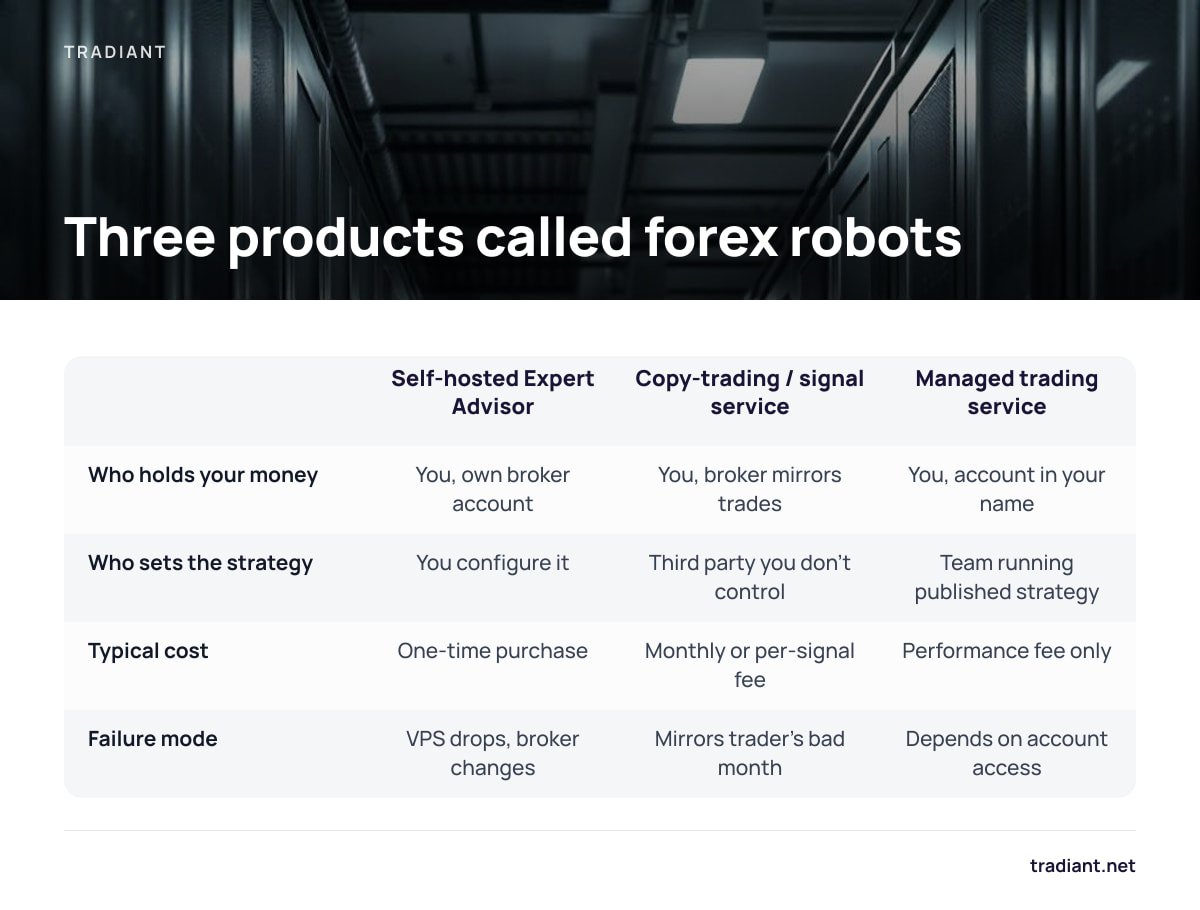
People searching "forex robot" usually land on one of three very different things, and the differences matter more than the marketing copy around any of them admits.
| Type | Who holds your money | Who sets the strategy | Typical cost |
|---|---|---|---|
| Self-hosted Expert Advisor | You, on your own broker account | You configure it, often from presets | One-time purchase, no ongoing fee |
| Copy-trading / signal service | You, broker mirrors another trader's trades | A third party you don't control day-to-day | Monthly subscription or per-signal fee |
| Managed trading service | You, broker account stays in your name | A team running a fixed, published strategy | Performance fee only, nothing charged flat |
Each row carries a different failure mode. The EA can stop working the moment your VPS drops or a broker changes its execution model. The copy service can keep mirroring a trader having a bad month with no way for you to intervene quickly. The managed service hinges entirely on whether it has actual access to place trades on your account, or custody of the money itself — a distinction Managed Account Forex is built around answering before you fund anything.
The Three Trading Styles Hiding Inside Most Robots
Underneath the packaging, almost every forex robot runs one of three underlying strategies, and each has a trade-off that doesn't show up in a glossy backtest chart.
- Trend following. The robot enters when price breaks a moving average, channel, or recent high/low, and tries to ride the move as long as it lasts. It struggles in choppy, sideways markets, where it takes frequent small losses waiting for a trend that doesn't arrive.
- Grid or martingale. The robot opens trades at fixed price intervals and increases position size to average down on losers, banking on price eventually reversing. It can look consistently profitable for months, then lose everything in one sustained move that never reverses.
- Scalping. The robot takes many small trades off tiny price moves and depends on very low spreads and fast execution to stay profitable. It struggles the moment spreads widen during news releases or thin overnight liquidity, which can turn a winning setup into a losing one instantly.
Pro Tip: Ask any seller for the out-of-sample period, not the headline return. If a robot's marketing only shows one continuous backtest with no stated start date for forward or live testing, you're being shown the period it was built to fit, not the period it was actually tested against.
Where Robots Break: Backtests, News Spikes, and Slippage
A strategy tuned on five years of EUR/USD data until it shows a smooth equity curve has usually been shaped to fit the noise in that specific period, not a repeatable edge — a problem traders call curve-fitting, and it's the single most common reason a robot that looked perfect in testing loses money live. Central bank rate decisions and major data releases like non-farm payrolls can move price several times faster than normal in the seconds after release, which is exactly when a robot's stop-loss logic is most likely to get a worse fill than it expected. Whether an order fills at your stop price or somewhere worse during that gap often comes down to the order type itself, a distinction Stop Loss Limit covers in detail.
ESMA capped retail leverage on major currency pairs at 30:1 for clients across the EU in 2018 — a limit most EU regulators, and the UK's FCA, still enforce, cutting the position size any robot can open with a given balance to a fraction of what brokers offered before.
Who's Actually Checking That This Works

Regulators don't test whether a forex robot is profitable — there's no certification body that scores trading strategies, and there probably never will be, since performance depends on market conditions nobody controls. What they do police is false claims and custody of client money. ASIC's MoneySmart warns that automated trading bots advertised with guaranteed or risk-free returns are a common scam pattern in Australia, and it treats that promise itself as a red flag regardless of the strategy behind it.
In the US, the CFTC and the National Futures Association require anyone managing retail forex accounts for a fee to register as a Commodity Trading Advisor or Commodity Pool Operator, a status you can check on the NFA's public BASIC database before funding anything. None of these rules certify that a robot will make you money — they exist to catch people who never had the authority to trade your account in the first place.
Renting, Buying, or Handing the Keys to Someone Else

Owning a robot outright means you're responsible for the VPS it runs on, the platform updates, and diagnosing why it silently stopped trading on a Tuesday afternoon. A managed account means someone else runs the strategy on infrastructure you never touch, but it only works in your favor if you know exactly who can access your money and under what authority before you sign anything.
A $500 account risking 1% per trade is risking $5 a trade — not the $50 many default robot settings assume, which is why sizing matters more than the strategy's win rate.
Fee structure changes the calculation too. A flat monthly subscription charges you whether the robot made money that month or not. A high-watermark success fee only charges on new profit above your previous peak balance, which means a losing month costs you nothing beyond the loss itself. If you're weighing your first few options against each other, Robots for Beginners walks through the checklist worth running before you fund any of them.
Get Hands-Off Forex Exposure Without Losing Sight of Who Holds the Money
Tradiant runs a managed automated trading service built around the exact ownership question this article keeps coming back to: the robot trades, but the money never leaves your name. It deploys a rotating squad of trading robots — currently a trend-following strategy called Goldenhawk — directly on your own broker account, starting from $500. You keep 80% of any profit; Tradiant takes a 20% high-watermark success fee only on new gains above your previous peak, with nothing charged in a losing month and no setup or monthly fee either way.
You can check which robot is active and which is benched on a live team sheet, and reach a human through 24/7 live chat or a booked call if something looks off. The honest caveat: Tradiant doesn't launch until early 2027, and no managed strategy, trend-following or otherwise, removes the drawdown months a robot like Goldenhawk is built to ride out — read the fee and risk disclosures before committing the $500.
Frequently Asked Questions
Can a forex robot guarantee profits?
No. Any claim of guaranteed or risk-free returns from a forex robot is treated as a warning sign by regulators like ASIC, because trading carries a chance of loss no matter how automated the process is.
Do I need coding skills to use a forex robot?
Not for most retail products. Self-hosted Expert Advisors usually ship with adjustable settings and a user guide, while managed services run the strategy for you on infrastructure you never have to touch.
How much money do I need to start?
It depends on the product. Buy-once Expert Advisors can run on almost any funded account, while most managed automated trading services set a minimum, often around $500, to keep position sizing sensible relative to the fee structure.
Is a forex robot the same as copy trading?
No. Copy trading mirrors another trader's live positions in near real time, while a forex robot executes its own fixed rule set without a human making case-by-case calls once it's running.
What's the biggest risk with a forex robot I download myself?
The strategy may be overfit to past data, and you're solely responsible for the VPS, platform updates, and diagnosing outages, since there's no support team checking that it's still running correctly.
Sources
- ASIC MoneySmart: automated trading scams | ASIC
- ESMA product intervention measures on CFDs and forex | ESMA
- NFA BASIC registration database | National Futures Association
- Commodity Trading Advisor registration | CFTC
