
Trading for beginners is less about picking currency pairs and more about one earlier decision: will you place the trades yourself, or let an automated system trade an account that stays in your name? Most new traders who lose money do it through leverage and emotional decisions, not bad analysis. If you have $500 and limited time, the route that keeps custody with you, caps your leverage, and charges only on profit gives you the fairest start.
TL;DR:
- Every beginner chooses one of four routes: manual trading, copy trading, a DIY robot, or a managed robot on your own account.
- Leverage causes more beginner losses than bad analysis. At 30:1, a 1% move against you takes 30% of a $500 account.
- Regulators in the EU and Australia cap retail leverage at 30:1 on major pairs. The US cap is 50:1.
- Keep your money in a regulated broker account in your own name. Never hand over funds directly to a trader or robot seller.
- Prefer fees charged only on new profit, through a high-watermark model, over monthly, setup, or upfront charges.
Table of Contents
- Trading for Beginners: The Four Routes, and Which One Fits $500
- Leverage Is the Real Opponent, Not the Market
- Why Most Beginners Lose, and What Regulators Have Measured
- Where Robots Help a Beginner, and Where They Don't
- Custody First: Who Holds the Money Decides How Bad a Bad Day Gets
- Fees That Pay When You Win, and Fees That Pay Regardless
- A 30-Day Starter Plan Before Real Money Goes In
- Get a Hands-Off Robot Squad Running on Your Own Broker From $500
- Frequently Asked Questions
- Sources
Trading for Beginners: The Four Routes, and Which One Fits $500
Before you open a chart, decide who presses the buttons. A beginner with $500 has four realistic ways into forex, and they differ far more in time, skill, and custody than in potential return.
| Route | Time per week | Skill needed | Who holds your money | Biggest beginner risk |
|---|---|---|---|---|
| Manual trading | 5–15 hours | High | You, at your broker | Emotional decisions and overtrading |
| Copy trading | 1–2 hours | Medium (picking whom to copy) | Usually you, at the platform's broker | Copying someone's lucky streak |
| DIY robot (buy and run it yourself) | 2–5 hours | Medium-high (setup, servers, settings) | You, at your broker | Wrong settings, no monitoring |
| Managed robot on your own account | Under 1 hour | Low | You, at your broker | Robot underperforms in a bad market phase |
Here is our position. If you want to learn trading as a skill, start manually on a demo account and accept that it takes months. If you want forex exposure without making a second job of it, a managed robot running on a broker account in your name is the most sensible beginner route. You keep custody, you skip the setup mistakes, and someone else watches the system.
Copy trading looks easy, but it puts the hardest decision on you. Choosing whom to follow means judging a trader's record, and a beginner cannot tell skill from a hot streak in a three-month chart.
Leverage Is the Real Opponent, Not the Market
Leverage lets a small deposit control a much larger position. It is the main reason beginner accounts empty quickly, and it deserves more of your attention than any indicator.
Regulators set hard ceilings for retail traders. The European Securities and Markets Authority (ESMA) introduced limits of 30:1 on major currency pairs and 20:1 on non-major pairs, along with negative balance protection, so EU retail clients cannot lose more than they deposit. The Australian Securities and Investments Commission (ASIC) applies the same 30:1 cap on major pairs for retail clients. In the US, the Commodity Futures Trading Commission (CFTC) limits retail forex leverage to 50:1 on major pairs and 20:1 on others.
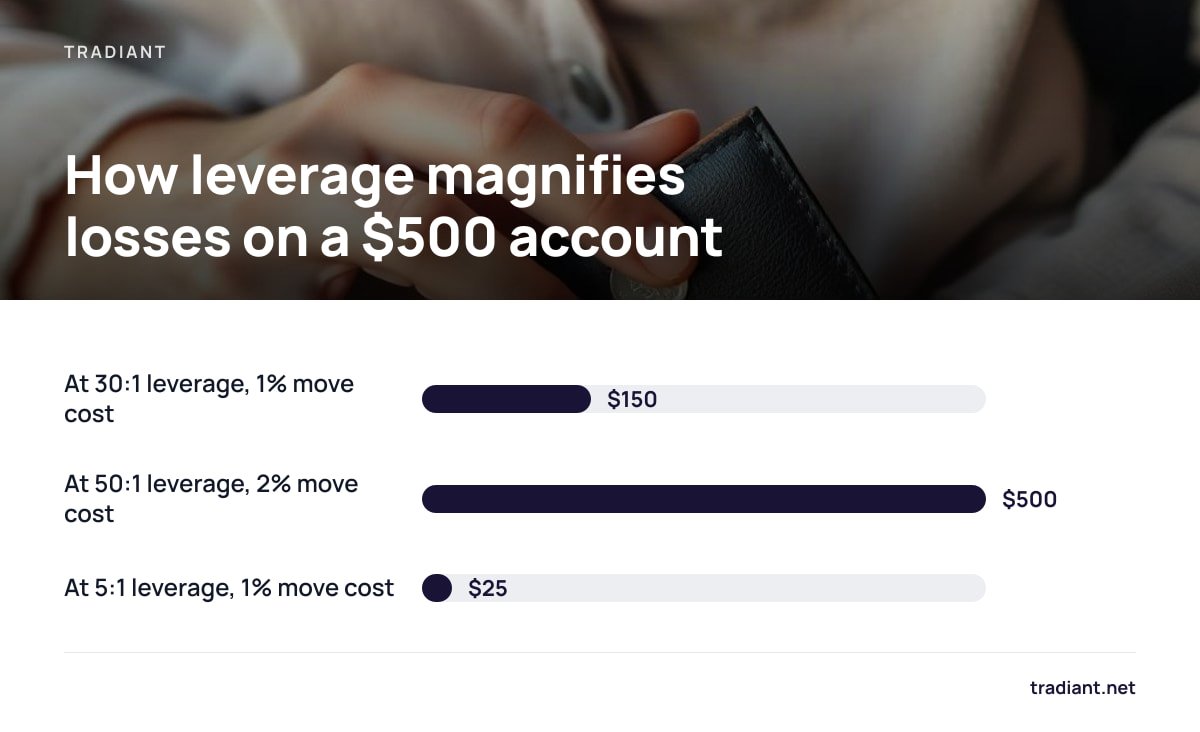
Run the numbers on a $500 account:
- At 30:1, $500 controls $15,000. A 1% move against you costs $150, which is 30% of your account.
- At 50:1, $500 controls $25,000. A 2% move against you wipes out the full $500.
- At an effective 5:1, $500 controls $2,500. A 1% adverse move costs $25, which is 5% of your account and survivable.
At 50:1 leverage, a 2% move in the wrong direction erases a $500 account entirely. EUR/USD can move that much in a single volatile week.
The maximum leverage a broker offers is a ceiling, not a target. Think of it like a speed limit. The sign says 120, but nobody learning to drive should be doing 120.
Why Most Beginners Lose, and What Regulators Have Measured
The forex market is huge. The Bank for International Settlements' 2022 Triennial Survey put average daily turnover at about $7.5 trillion. That size does not make it friendly to small accounts.
When ESMA reviewed retail trading of leveraged products, it found that between 74% and 89% of retail accounts typically lose money. That finding is why EU brokers must now show a risk warning stating what percentage of their own retail accounts lose money. Check that figure on any broker's homepage before you sign up.
The losses tend to come from the same few habits:
- Oversized positions. Beginners size trades by how much they hope to make, not by how much they can afford to lose. One bad trade then does the damage of ten.
- Moving or skipping stop losses. A loss you planned to cap at 2% becomes 20% because you "gave it room." Read our breakdown of stop loss vs stop limit orders to see why the order type also decides whether you get filled at all.
- Revenge trading. After a loss, you double the next position to win it back. This is the trading version of chasing a deficit with long shots in the first quarter.
- Trading the news. Spreads widen sharply around major releases such as US non-farm payrolls. A beginner's stop can fill well past its set level.
- No written rules. Without a written plan, every decision is made in the moment, under pressure.
Notice that almost none of these are analysis failures. They are discipline failures, which is exactly where automation earns its place.
Where Robots Help a Beginner, and Where They Don't
A trading robot, also called an expert advisor, follows fixed rules. It does not revenge-trade, does not move its stop because it feels lucky, and does not skip a signal because the last three lost. For a beginner, that consistency is the main benefit.
A robot does not remove market risk, though. A trend-following system makes money when markets trend and gives some back when they chop sideways. No robot wins every month, and anyone who says otherwise is selling something you should walk away from. The CFTC repeatedly warns about forex schemes that promise guaranteed or unusually high returns.
What a robot changes:
- Removes emotion. It applies the same entry, exit, and position size every time.
- Runs while you sleep. Forex trades around the clock on weekdays, and a robot covers sessions you can't.
- Enforces sizing. A well-built robot sizes each trade to a fixed risk, which addresses the biggest beginner mistake directly.
What a robot doesn't change:
- Market regime risk. A strategy built for trends will struggle in flat markets.
- Bad settings. If you run it yourself with the wrong lot size or leverage, it will compound your mistake perfectly.
- Overfitting. A backtest tuned to look flawless on old data often fails on live data.
Our guide to what matters before you fund a robot covers how to read a track record. For a plain walkthrough of the mechanics, see how automated forex trading works and what $500 gets you.
Pro Tip: When you look at any robot's results, ignore total return and find the worst peak-to-trough drawdown, then ask how long the account took to recover from it. A system that dropped 25% and needed eight months to recover will test your nerves far more than its headline return suggests. Most beginners quit at the bottom of that drawdown, so they lock in the loss and miss the recovery.
Custody First: Who Holds the Money Decides How Bad a Bad Day Gets

The question that separates a reasonable service from a dangerous one is simple: whose name is on the account?
On a safe setup, your money sits with a regulated broker in an account you own. A robot or manager gets permission to place trades but cannot withdraw funds. If you lose confidence, you revoke access and your balance stays where it is.
On a risky setup, you send money to the trader, the robot seller, or a "fund" you can't verify. Once the money leaves your name, your protection depends entirely on their honesty.
Rule of thumb: if a forex service asks you to deposit money with it rather than with a regulated broker in your own name, stop there.
Before funding anything, check the broker's registration yourself. In the US, the National Futures Association's BASIC database shows whether a firm is registered for retail forex. In Australia, search ASIC's professional register, and in the EU, check your national regulator's register. Our explainer on managed account forex covers trading permissions and withdrawal rights in more detail.
Fees That Pay When You Win, and Fees That Pay Regardless

Fees shape your results more than most beginners expect. On a $500 account, a $30 monthly subscription is $360 a year, which is 72% of your starting balance gone before a single trade.
The common fee models compare like this:
- Monthly subscription. You pay whether the robot makes or loses money. This is the worst fit for small accounts.
- Upfront purchase. You pay once, then carry all the setup and monitoring yourself.
- Profit share without a high watermark. You pay on gains, but you can also pay twice for recovering the same lost ground.
- Profit share with a high watermark. You pay only on new profit above the account's previous peak.
Here is how the high watermark works on a $500 start. In month one, the account grows to $600, so a 20% fee applies to the $100 gain. In month two, it falls to $550, so you pay nothing. In month three, it climbs to $620, and you pay only on the $20 above the old $600 peak, not on the $70 recovery. The manager's incentive matches yours: they earn only when your account reaches new highs.
We would pick a high-watermark model over any other structure for a beginner, and we think you should too. For the full mechanics, read our guide to no-monthly-fee managed forex.
A 30-Day Starter Plan Before Real Money Goes In

Treat your first month as preseason. Nothing counts yet, but everything you learn carries forward.
Week 1: Choose and verify a broker
Open a demo account with a broker regulated in your region. Confirm its registration on the regulator's own website, not through a link the broker provides. Note its published percentage of retail accounts that lose money.
Week 2: Learn the position-size math
On EUR/USD, one pip is worth about $10 on a standard lot (100,000 units) and about $0.10 on a micro lot (1,000 units). With $500, micro lots are your realistic size. Work out what a 20-pip stop costs at different sizes until the math becomes automatic.
Week 3: Pick your route
Use the table at the top of this guide. Be honest about how many hours you will really spend each week, not how many you hope to spend.
Week 4: Set your loss limit in writing
Decide the drawdown that would make you stop or pause. For example, write down: "If the account falls to $375, I stop and review." Writing it down before you start removes the in-the-moment negotiation that sinks most beginners.
Only after these four weeks should real money go in, and only money you could lose without it affecting rent or bills.
Get a Hands-Off Robot Squad Running on Your Own Broker From $500
Tradiant is built around the problems this guide covers. Your money stays in your own broker account. Our robots, starting with Goldenhawk, a trend-following system, trade with fixed risk sizing so emotion and oversized positions never enter the picture. There are no monthly, setup, or management fees. You keep 80% of profits and pay a 20% success fee only on new gains above your high watermark, and you pay nothing in losing months. A live team sheet shows which robots are active and which are benched, and you can reach a real person through 24/7 live chat or a free booked call.
The honest part: Tradiant opens in early 2027, so there is no live client track record to show you yet. Goldenhawk is a trend follower, which means flat, choppy markets will produce losing stretches. Read our risk disclosures as closely as you would anyone else's before you commit a dollar.
Frequently Asked Questions
How much money do I need to start trading forex as a beginner?
Many regulated brokers let you open an account with $100 or less, but $500 gives you enough room to trade micro lots with sensible risk per trade. Treat whatever you start with as money you could lose entirely. The amount matters less than keeping leverage low.
Is forex trading with a robot safe for beginners?
A robot removes emotional mistakes but not market risk, so it can still lose money, especially when market conditions change. It is safer when it runs on a regulated broker account in your name and you can revoke its trading access at any time. Avoid any service that asks you to send money to it directly.
What leverage should a beginner use?
Far less than the maximum. EU and Australian rules cap retail leverage at 30:1 on major pairs, and the US cap is 50:1, but an effective 5:1 or lower keeps a single bad move survivable. At 30:1, a 1% move against you costs 30% of your account.
What is a high-watermark fee in managed forex?
A high-watermark fee is charged only on profit that takes your account above its previous highest value. If your account drops and then recovers, you pay nothing on the recovery, only on new gains beyond the old peak. This keeps the manager's incentive tied to growing your account.
Why do most beginner forex traders lose money?
ESMA found that 74% to 89% of retail accounts typically lose money on leveraged products. The usual causes are oversized positions, moved stop losses, revenge trading after losses, and having no written rules. These are discipline problems more than analysis problems.
Sources
- European Securities and Markets Authority | ESMA
- Commodity Futures Trading Commission | CFTC
- Triennial Central Bank Survey of Foreign Exchange Turnover 2022 | Bank for International Settlements
- Australian Securities and Investments Commission | ASIC
- National Futures Association | NFA
