
To withdraw forex trading funds, log into your broker's client portal, open the withdrawal page, choose the method you deposited with, and request an amount from your free margin. Free margin is the number that matters, because money backing open trades cannot leave. On a $500 account, minimums and fees decide how much actually reaches you, so check them before you deposit.
TL;DR:
- You can only withdraw free margin, not your full balance, because open trades lock up part of your money.
- Most brokers send money back the way it came in, so plan your withdrawal method when you make your first deposit.
- Complete identity verification before you need the cash, since that is the most common cause of delays.
- Flat withdrawal fees hurt small accounts: a $25 wire on a $100 payout costs you a quarter of it.
- If a robot or managed service trades your account, you still withdraw through your own broker, and you should ask how withdrawals affect any performance fee.
Table of Contents
- Free Margin vs. Balance: What You Can Actually Pull Out
- How to Withdraw Forex Trading Funds, Step by Step
- Withdrawal Methods Compared: Speed and Cost on a Small Account
- Why Brokers Send Money Back the Way It Came
- Where Small Accounts Lose Money on the Way Out
- When a Withdrawal Is Delayed or Rejected, and What to Do
- Withdrawing From an Account a Robot or Manager Trades
- Get a Robot-Run Account With Withdrawals You Control
- Frequently Asked Questions
- Sources
Free Margin vs. Balance: What You Can Actually Pull Out
Your account screen shows several numbers, and only one of them is your withdrawal limit. Balance is the money in the account before open trades are counted. Equity is balance plus or minus the floating profit or loss on those trades. Free margin is equity minus the margin your open positions are using, and it is the most you can request.
Say you have a $500 balance with a trade open that holds $120 of margin and is down $30. Your equity is $470, your free margin is $350, and $350 is your ceiling. Ask for more and the portal will reject it. Withdraw too much with trades open and you risk a margin call, where the broker starts closing positions for you.
The same rules apply if a robot is placing the trades. How those systems work, and what a $500 start realistically buys, is covered in our guide to automated forex trading. For withdrawals, the only difference is that you should check the account for open positions before you ask for money, because a robot may open a new trade at any time.
How to Withdraw Forex Trading Funds, Step by Step
The steps are nearly identical across brokers, though the menu names differ.
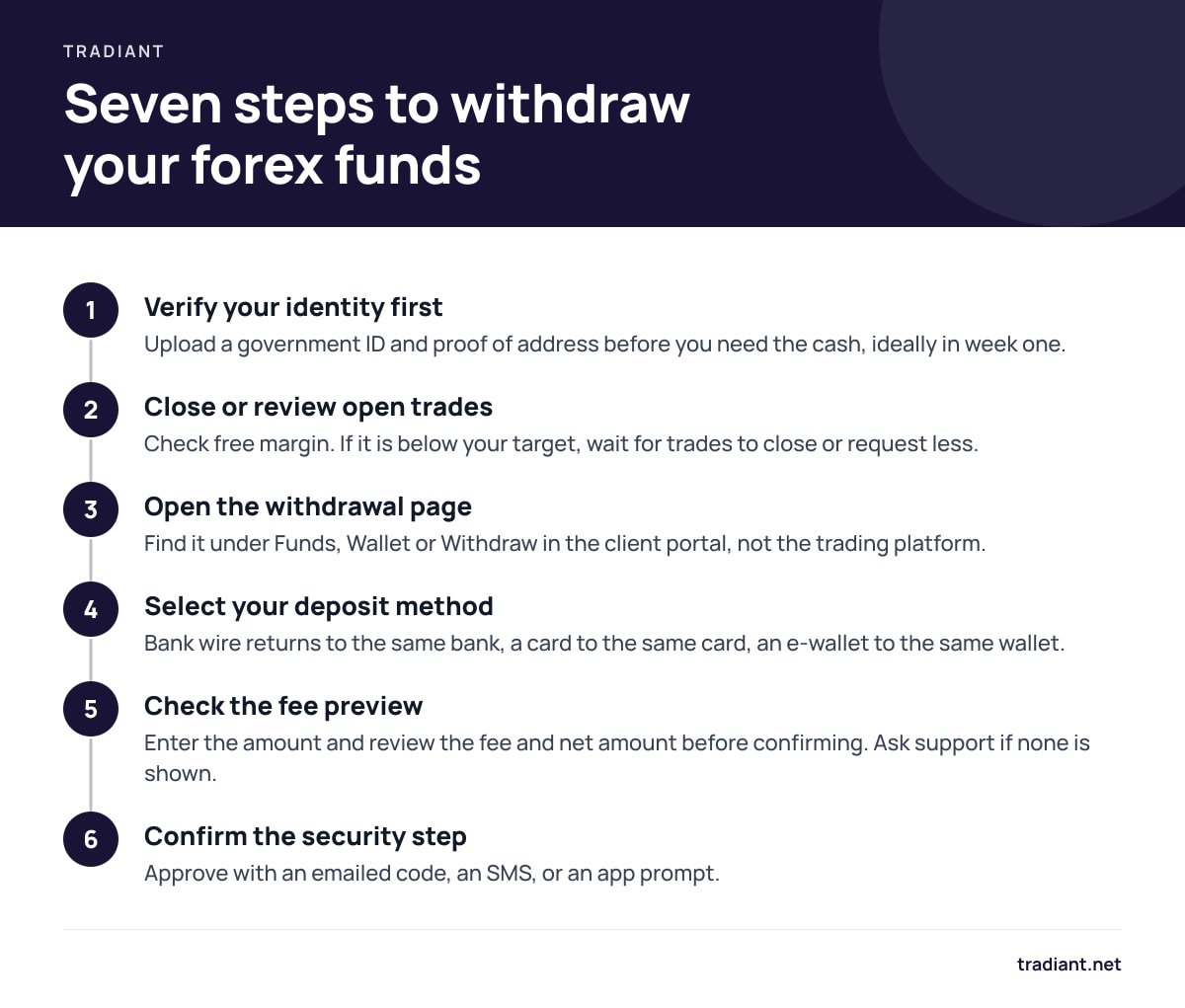
- Verify your identity first. Upload a government ID and proof of address if you have not already. Do this in week one, not on the day you need cash.
- Close or review open trades. Look at free margin. If it is lower than your target, either wait for trades to close or request a smaller amount.
- Open the withdrawal page. It is usually under "Funds," "Wallet," or "Withdraw" in the client portal, not in the trading platform itself.
- Select the method you deposited with. Bank wire goes back to the same bank account, a card to the same card, an e-wallet to the same wallet.
- Enter the amount and check the fee preview. Many portals show the fee and the net amount before you confirm. If yours does not, ask support first.
- Confirm with the security step. That may be an emailed code, an SMS, or an app prompt.
- Track the request. Status usually moves from "pending" to "approved" to "sent." The broker's review is one stage, and your bank or wallet adds its own time afterward.
If a trade is in profit and you are tempted to pull money out mid-position, wait. Floating profit is not yours until the trade closes, and a reversal can erase it before the request is approved.
Withdrawal Methods Compared: Speed and Cost on a Small Account
Every broker publishes its own schedule, so treat these as typical ranges and confirm against your broker's payment page.
| Method | Typical speed after approval | Typical cost pattern | Best for |
|---|---|---|---|
| Bank wire | 1 to 5 business days | Flat fee, often charged by the broker, the intermediary bank, or both | Larger withdrawals |
| Debit or credit card | 3 to 10 business days | Often free, but refunds may be capped at what you deposited by card | Small, early withdrawals |
| E-wallet | Same day to 1 business day | Percentage fee at the wallet or broker | Frequent, smaller amounts |
| Crypto | Minutes to a few hours | Network fee plus possible conversion spread | Accounts funded in crypto |
My pick for a $500 account is whichever method has no flat fee and matches how you funded the account. For most beginners that is the card or e-wallet route. Wires make sense once you withdraw amounts where a $20 to $40 charge is a rounding error.
Why Brokers Send Money Back the Way It Came
Brokers refuse to pay a different card or a third party's bank account because of anti-money-laundering standards. The Financial Action Task Force sets them and calls for customer due diligence, which is why you submit ID and why payouts are tied to accounts in your own name. A broker that pays an unverified third party risks its license.
Two practical consequences follow.
- Card first. Many brokers will return money to the card you used, up to the amount you deposited on it, before sending profits by another route. If you funded with $500 on a card and now hold $650, expect $500 to go back to the card and the $150 profit to go by wire or e-wallet.
- Name matching. The name on the bank account or wallet must match the name on the trading account. A partner's or a company's account will be refused.
Your money is also safer when the broker is regulated somewhere that enforces client money segregation. The UK's Financial Conduct Authority requires firms to hold client money separately from their own under its CASS 7 rules. In the US, retail forex dealers must register with the Commodity Futures Trading Commission and belong to the National Futures Association, whose BASIC database lets you look up a firm in a minute. Check that before the first deposit, not after a payout stalls.
Where Small Accounts Lose Money on the Way Out
Withdrawal costs are mostly flat, and flat costs punish small balances.
A $25 wire fee on a $100 withdrawal takes 25% of it. The same fee on $1,000 takes 2.5%.
Watch for these:
- Flat wire fees. Your broker may charge one, and your bank's intermediary may take another. The amount that lands can be lower than the amount you approved.
- Minimum withdrawal amounts. Some brokers set floors such as $50 or $100 for certain methods, so a small profit may sit in the account until it clears the floor.
- Currency conversion. If your account is in USD and your bank is in euros or Australian dollars, the exchange spread is another cost. Hold the account in your bank's currency if you can.
- Free withdrawals per month. A broker might waive fees on one request a month and charge for the rest, so fewer, larger withdrawals cost less.
- Bonus conditions. If you accepted a deposit bonus, withdrawals may be blocked until you hit a trading volume target. On a $500 account I would skip bonuses entirely.
Pro Tip: Make a small test withdrawal in your first two weeks, even if it is only the minimum allowed. It forces your verification to clear, shows you the real fee and arrival time, and proves the payment route works while there is no pressure. A payout that fails when you urgently need rent money is much harder to fix than one that fails during a trial run.
When a Withdrawal Is Delayed or Rejected, and What to Do
Most stalls come from a short list of causes.
Verification gaps
A blurry document, an expired ID, or an address proof older than the broker's cutoff (often three months) will freeze the request. Re-upload a clear, current file and reply to the broker's email on the same day.
Method or name mismatches
If you deposited by card and request a wire, or the receiving account is in another name, the broker will reject or reroute it. Request the method that matches the original deposit.
Insufficient free margin
The request may be approved on screen and then canceled when a trade moves against you. Leave a cushion rather than withdrawing every dollar of free margin.
Slow processing windows
Brokers often process payouts on business days only, with a daily cutoff time. A request sent Friday evening may not move until Monday. Add your bank's processing time on top.
If more than the stated processing time has passed, use live chat and ask for the transaction reference. If that goes nowhere, file a written complaint with the broker, then escalate to its regulator. This is a good reason to choose a regulated firm in the first place.
Withdrawing From an Account a Robot or Manager Trades
When a managed service or robot trades your own broker account, the withdrawal process is the one above. The money never left your broker, so you request it there. That is the main advantage over setups where a provider pools your funds. Our piece on how a $500 managed forex account works and what it risks goes through the custody question in detail, and the steps for a different model are in our guide to withdrawing from a copy trading account.
Settle these before you start:
- Open positions. Ask whether you should withdraw only when the robot is flat, or whether partial withdrawals are fine mid-trade. Taking equity out while positions are open changes the margin cushion those trades were sized for.
- Performance fees and high-watermark. If a fee is charged only on new profit above your previous peak, ask how a withdrawal is treated in that calculation. Get the answer in writing.
- Position sizing. A smaller balance usually means smaller trade sizes, so a large withdrawal changes the strategy's earning potential as well as your balance.
On taxes, the usual taxable event in many countries is the realized trading gain rather than the act of withdrawing, but rules differ by country. Our comparison of how copy trading and managed accounts are taxed is a good starting point, and a local tax professional should have the last word.
Get a Robot-Run Account With Withdrawals You Control
Most withdrawal questions come down to whether you can get your money out when you want it. Tradiant is built around that. It runs a rotating squad of trading robots, currently Goldenhawk, on your own broker account, so your funds stay with your broker in your name and you withdraw through the same portal described above. Pricing starts from a $500 account. You keep 80% of profits and pay a 20% high-watermark success fee, with no setup, monthly, or management fees and nothing charged in a losing month.
One limit to know up front: the service opens in early 2027, and your broker's own withdrawal fees, minimums, and processing times still apply, since the broker sets those, not us. Ask how withdrawals interact with the high-watermark before you fund anything. The 24/7 human live chat and free booked calls exist for exactly that kind of question, and you should get a straight answer in writing.
Frequently Asked Questions
How long does it take to withdraw forex trading funds?
Brokers typically review requests within one business day, and then the payment method sets the clock: e-wallets can arrive the same day, bank wires often take 1 to 5 business days, and cards can take a week or more. Check your broker's published schedule, because it varies by firm and by method.
Can I withdraw all my money from a forex account at once?
You can withdraw your entire free margin, which is the full balance only when you have no open trades. Close positions first if you want to empty the account, and check for any minimum balance or account closure steps your broker requires.
Why does my broker want to send money back to my original deposit method?
Anti-money-laundering rules require brokers to verify customers and trace funds, so payouts generally go back to a source in your own name. Many brokers return deposits to the original card first, then pay profits by another verified method.
Are forex withdrawals taxable?
In many countries the taxable event is the realized gain from trading, not the withdrawal itself, but treatment varies widely by jurisdiction and account type. Keep your broker statements and speak to a local tax professional.
What should I do if my withdrawal has been pending for too long?
Contact the broker's support with your transaction reference and confirm that verification is complete and the method matches your deposit. If the stated processing time has passed with no resolution, file a written complaint and escalate to the broker's regulator.
Sources
- FATF Recommendations on customer due diligence and anti-money laundering | Financial Action Task Force
- Client Assets Sourcebook (CASS 7, client money rules) | Financial Conduct Authority
- Retail forex dealer oversight and BASIC database | National Futures Association
- Retail forex resources | U.S. Commodity Futures Trading Commission
